
Source: Lawrence Berkeley National Laboratory
“The rapidly increasing demand for generative artificial intelligence (AI) models requires extensive server installation with sustainability implications in terms of the compound energy–water–climate impacts. Here we show that the deployment of AI servers across the United States could generate an annual water footprint ranging from 731 to 1,125 million m3 and additional annual carbon emissions from 24 to 44 Mt CO2-equivalent between 2024 and 2030, depending on the scale of expansion.” — Environmental impact and net-zero pathways for sustainable artificial intelligence servers in the USA[1]
By Kevin Policarpo
Electricity prices have jumped 40% since February 2020, according to the Bureau of Labor Statistics. That’s a bigger jump than the 26% increase in the overall cost of living. The demand for electricity, which barely grew in the 2000s and 2010s, has steadily grown as more people and businesses plug into the power grid.[2]
A.I. data centers are being built at a rapid pace with operational centers expending more electricity to operate for longer periods of time, which is stressing the U.S. power grid.
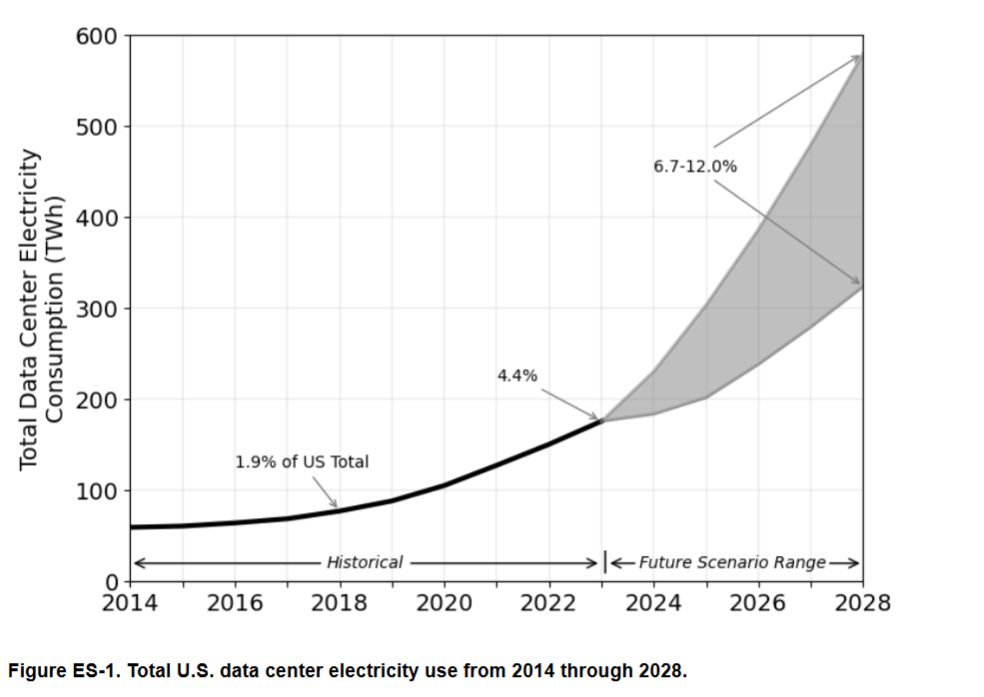
Lawrence Berkeley National Laboratory has reported that power consumption from data centers supporting A.I. usage has risen from 76 terawatts (TWh) in 2018, with projections of data center power consumption ranging between 325 and 580 terawatts by 2028.
Analysts from Wood Mackenzie have stated that investments in the U.S. power grid are forecasted to grow by 23% between 2025 and 2030.
An NPR article states that with more people and businesses plugging into the power grid, electricity and gas prices are increasing along with demand, especially due to the A.I. boom.
A Nature Sustainability report discusses the impact of A.I. usage on the environment in terms of emissions produced by the data centers and the efforts to accurately quantify the overall amount.
Data Centers Drive New Energy Demand
With the growing demand for power, the construction of new data centers to power A.I., and the need for further electrification to boost the economy, the U.S. energy grid is receiving more investments to modernize and expand.
The most pressing reason for grid modernization is due to the construction of new data centers and using more power for both A.I. and for online services. The data centers are kept in operation for longer periods of time, which use up more electricity. The Lawrence Berkeley National Laboratory published a report in 2024 that discussed how much electricity was being used by data centers.
The report stated that annual energy use in U.S. data centers started increasing in 2017 as “…the overall server installed base started growing and Graphic Processing Unit (GPU)- accelerated servers for artificial intelligence (AI) became a significant enough portion of the data center server stock that total data center electricity use began to increase again, such that by 2018 data centers consumed about 76 TWh, representing 1.9% of total annual U.S. electricity consumption.”[3] The energy usage rate has continued to grow, with energy use at U.S. data centers reaching 176 terawatts in 2023, which represented 4.4% of total U.S. electricity consumption that year.[4]
The rapid growth of A.I., data center power usage after 2023 has been set into a range of various scenarios. These scenarios include factors such as future equipment shipments and operational practices, cooling usage, assumed number of GPUs shipped each year due to demand and manufacturers meeting said demands, average computational power used by GPU-accelerated servers and how often A.I. hardware is used to meet with A.I. workload demand. As such, the scenario variations together provide a range of data center energy estimates of between 325 and 580 TWh in 2028.[5] Assuming that the data centers use a maximum power output of 50% every year, the “…annual energy use range would translate to a total power demand for data centers between 74 and 132 GW. This annual energy use also represents 6.7% to 12.0% of total U.S. electricity consumption forecasted for 2028.”[6]
Source: Lawrence Berkeley National Laboratory
According to analysts at Wood Mackenzie, a research and consulting firm for the energy, chemicals and natural sources sector, “Grid investments are forecast to increase by 23% between 2025 and 2030…”[7] Ben Boucher, Senior Analyst for Supply Chain Data and Analytics at Wood Mackenzie spoke with Reuters about the need for more power infrastructure, “Investments in new manufacturing facilities have surged in recent years, rising 184% since 2020, and new factories require electrical equipment and grid infrastructure…”[8] The recent push for improvements to the power grid is due to concerns about the amount of power the new data centers will need in order to use advanced A.I. programming.
California Switches From Clean Energy Expansion To AI
With the recent curtailment of clean energy programs by the Trump administration, power companies are investing in other modernization efforts for the power grid. For example, the California Independent System Operator (CAISO), has shifted from investments in connecting new clean power generation to investments in connecting data centers and electrification of buildings and transportation. Another example was stated in an announcement by Pacific Gas & Electric (PG&E) back in September 2025, in which the company would invest $73 billion dollars to upgrade the power transmission system in the state by 2030, aiming to accommodate 10 GW of power demand for new data centers over the next decade.[9] This effort is concurrent with PG&E’s plan “…to complete 500 miles of wildfire safety system upgrades in 2025-2026 and install almost 700 miles of underground power lines in 2026-2028.”[10]
Is AI Making Electric Bills More Expensive?
Electricity prices have jumped 40% since February 2020, according to the Bureau of Labor Statistics. That’s a bigger jump than the 26% increase in the overall cost of living, as cited by NPR in a November 6th, 2025 report.[11]
The demand for electricity, which barely grew in the 2000s and 2010s, has steadily grown as more people and businesses plug into the power grid.
A report from the Department of Energy projected:
“Electricity demand growth in our forecast is driven by the commercial and industrial sectors. We expect electricity sales to the commercial sector to rise by 3.0% in 2025 and 4.5% in 2026, driven largely by more demand from data centers, while electricity sales to industrial consumers rise by 2.0% in 2025 and 3.5% in 2026.”[12]
Drew Malony, president of the Edison Electric Institute, which represents power companies across the U.S., stated the following: “There’s automobiles that have gone from gasoline-powered to electric vehicles … You’re also seeing stoves being replaced from gas to electric. And the AI data center growth.”[13]
Utility companies have been working to replace old power plants with new ones and building up additional power with clean alternatives such as wind, natural gas and solar. However, the utilities have stated that “…building new power supplies along with a more resilient electric grid will cost more than a trillion dollars over the next five years.”[14] In theory, the data centers that are supporting artificial intelligence should be able to cover their own energy costs and potentially lower electricity bills for nearby residential customers. However, according to the Energy Department: “If data centers are given a break on prices, residential customers could end up saddled with some of their costs. Across the country, residential customers typically pay higher rates than commercial or industrial power users…”[15]
According to a report from the Center for American Progress, “…as of September 4, 2025, at least 102 gas and electric utilities have either raised or proposed higher rates that would go into effect in 2025 or 2026. Nearly 50 percent of the nation’s electricity utility customers (81 million) and more than one-third of natural gas customers (28 million) will be affected.”[16]
The Effects of Powering A.I. on the Environment
A report in Nature Sustainability found that: “We show that the AI server industry is unlikely to meet its net-zero aspirations by 2030 without substantial reliance on highly uncertain carbon offset and water restoration mechanisms.”[17]
While the growth of A.I. has led to a number of benefits such as advancing sustainability, “…the remarkable energy requirements of AI itself raise concerns regarding not only energy provisioning challenges but also water scarcity and climate change issues stemming from the energy–water–climate nexus of AI data centres.”[18]
The International Energy Agency stated that “…0.6% of global total carbon emissions comes from the data centres and data transmission networks due to their electricity consumption.”[19] Industry energy consumption could be doubled by 2026 due to A.I. and other sectors, “… threatening decarbonization targets under the Paris Agreement, which include a 53% reduction in data-centre emissions by 2030 and net-zero goals for the AI sector.”[20]
FOOTNOTES
[1] https://www.nature.com/articles/s41893-025-01681-y
[2] https://www.npr.org/2025/11/06/nx-s1-5597971/electricity-bills-utilities-ai
[3] https://escholarship.org/uc/item/32d6m0d1
[4] Ibid.
[5] Ibid.
[6] Ibid.
[7]https://www.reuters.com/business/energy/us-grid-investors-focus-demand-hotspots-planning-shift–reeii-2025-10-20/
[8] Ibid.
[9] Ibid.
[10] Ibid.
[11] https://www.npr.org/2025/11/06/nx-s1-5597971/electricity-bills-utilities-ai
[12] https://www.eia.gov/outlooks/steo/archives/aug25.pdf
[13] https://www.npr.org/2025/11/06/nx-s1-5597971/electricity-bills-utilities-ai
[14] Ibid.
[15] Ibid.
[16]https://www.americanprogress.org/article/residents-in-at-least-41-states-and-washington-d-c-are-facing-increased-electric-and-natural-gas-bills/
[17] https://www.nature.com/articles/s41893-025-01681-y
[18] Ibid.
[19] Ibid.
[20] Ibid.