
Photo: CCTV News
By Stas Margaronis and Kevin Policarpo
As China builds up is drone capability, Taiwan and the United States are struggling to catch up.
China’s Drone Build-Up
According to a Small Wars Journal report: “Across the Taiwan Strait, the PLA Rocket Force has an arsenal of thousands of ballistic missiles, cruise missiles, and glide bombs. Chinese firms account for nearly 90% of the commercial drone market; Da-Jiang Innovations (DJI) alone controls nearly 70% of the global market and manufactures most of the key hardware in commercial and military drones. Furthermore, it is estimated that, if ordered to do so, Chinese manufacturers could retool civilian drone factories to produce almost one billion weaponized drones per year. DJI drones like the MAVIC are used to great effect in Ukraine and can be weaponized for one-way attack missions for a few thousand dollars. Considering that it is standard practice to fire multiple interceptors against one drone or ballistic missile, the cost-benefit ratio of advanced missile defense systems is clearly in the PLA’s favor.”
Given this comparative advantage, the PLA could employ a figurative “offense in depth,” swarming thousands of cheap drones for the same cost as a single PAC-3 missile (U.S. Patriot missile). This would easily overwhelm Taiwan’s air defenses, deplete interceptor stockpiles, drive up the cost of resistance, and clear a path for PLARF missiles.[1]
This is happening as China has also stationed obsolete supersonic fighters converted to attack drones at six air bases close to the Taiwan Strait, according to a new report by the Mitchell Institute for Aerospace Studies. Satellite imagery of these airfields from the February report, “China Airpower Tracker,” shows what appears to be lines of stubby, swept-winged aircraft matching the shape of J-6 fighters that first flew with the Chinese air force in the 1960s. Since their conversion to drones, these aircraft have been identified at five bases in Fujian Province and one in Guangdong Province, according to the Arlington, VA based institute by Reuters.[2]
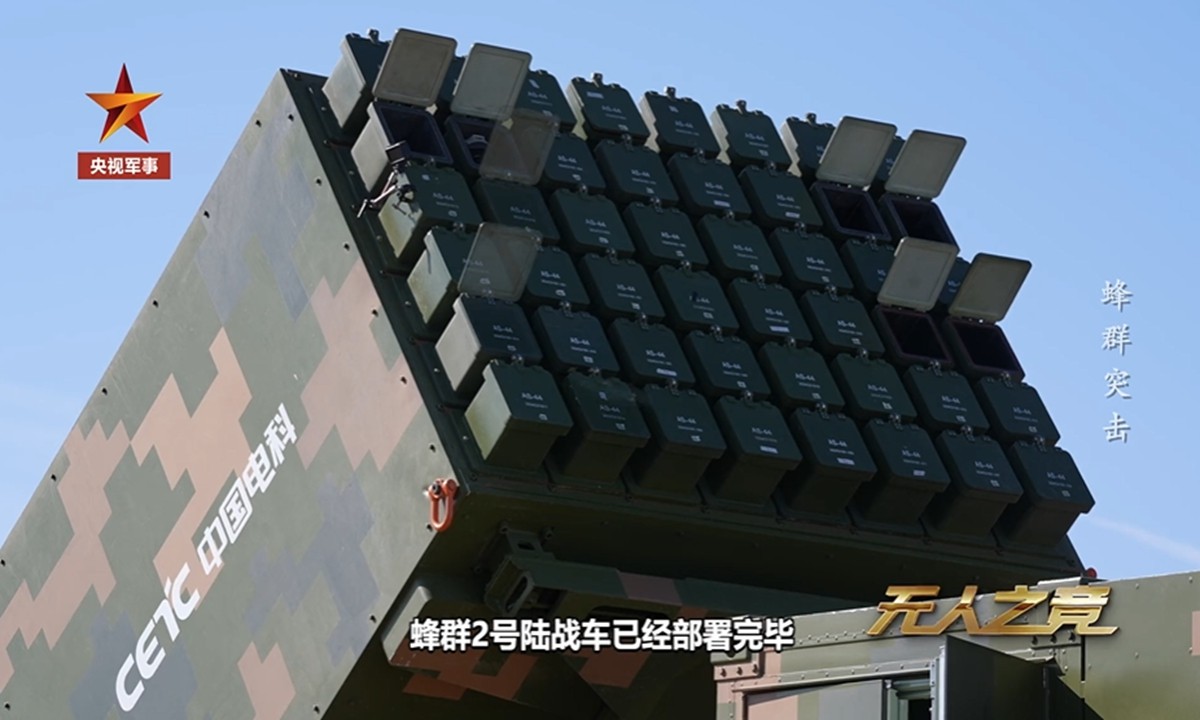
China’s Atlas drone swarm operations system, according to a military affairs expert, not only showcases expanding battlefield applications for drone swarms, but also reflects rapid advances in algorithm-driven technologies, which are reshaping modern warfare by enabling autonomous coordination, precision engagement, and system-level combat capabilities.[3]
Wang Yunfei, a Chinese military affairs expert, told China’s Global Times that the system could significantly expand battlefield applications, as it demonstrated modular task configurations:
- First, in saturation attacks against enemy air defense systems, large numbers of drones can be launched in multiple waves and directions to overwhelm interception capacity, making it difficult for defenders to process and respond effectively.
- Second, in precision strike missions, unlike traditional long-range munitions, whose accuracy can be affected by atmospheric conditions and electronic interference, drones can loiter over targets and conduct persistent surveillance, enabling strikes at closer range and with higher accuracy.
- Third, in deep-strike operations, drones with ranges extending hundreds or even thousands of kilometers can penetrate at low altitude with low speed and small radar cross sections, making early detection and interception more difficult and allowing effective strikes deep inside hostile territory, thereby blurring the traditional distinction between frontlines and depth areas.
Technologically, the expert said that these capabilities are driven by China’s advances in artificial intelligence and large models.[4]
Taiwan Capability
In October 2025, Republic of China President Lai Ching-te announced Taiwan would invest in a multi-layered air defense system known as “T-Dome” to defend against possible People’s Liberation Army (PLA) air attacks. The success of Israel’s Iron Dome against Iranian attacks last summer and the United States’ Golden Dome provided inspiration for this decision. However, the PLA has a massive drone production capacity could overwhelm the T-Dome with millions of low-cost drones and clear a path for deadly PLA Rocket Force (PLARF) rocket attacks, accordig to the Small Wars Journal report.[5]
An Economist report in March, The Parts China Cannot Reach, details the development of Taiwan’s drone programs:
- Taiwan has been building itself up as a supplier of “non-red” (aka, without Chinese-built components) for unmanned aerial vehicles (UAVs) to the U.S. and its Allies and other nations concerned about Chinese influence. Taiwan’s UAV production went from 10,000 units in 2024 to more than twelve times that in 2025 and it exported 123,000 in the same year.
- Taiwan’s drone program was started after observing Ukraine’s use of drones in their war with Russia. With the disparity in drone numbers compared to China, Taiwan is aiming to construct an entirely “non-red” UAV industry by the end of 2026 with a planned annual production rate of 180,000 units by 2028.
- The drive to build UAVs without Chinese components is due to most UAVs relying on parts from China, which account for 70-80% of global UAV production. Taiwan has been working to quickly replace Chinese components with domestically produced models, which has been relatively successful due to the nation’s advanced technology sector.
- Taiwan’s hope is that other democratic nations also take steps to remove Chinese built components from their own cheap UAV projects. The U.S. military has a requirement that their drones have no Chinese components and the government banned foreign imports, including components from DJI, China’s largest drone making corporation: “Weaning the West off China’s cheap drones will take time. But Taiwan has made a flying start.”[6]
U.S. Collaboration
While Taiwan is building up its own drone programs, Taiwan is also working with U.S. companies to expand its arsenal, according to the Taipei Times.
Taiwanese and U.S. defense groups are collaborating to introduce deployable, semi-autonomous manufacturing systems for drones and components in a boost to the nation’s supply chain resilience.
Taiwan’s G-Tech Optroelectronics Corp subsidiary GTOC and the US’ Aerkomm Inc announced an agreement with fellow U.S.-based Firestorm Lab to adopt the latter’s xCell, a technology featuring 3D printers fitted in 6.1m container units.
The systems enable aerial platforms and parts to be produced in high volumes from dispersed nodes capable of rapid redeployment, to minimize the risk of enemy strikes and to meet field requirements, they said.[7]
U.S. Trails China
The Chairman of the Senate Armed Services Committee Senator Richar Wicker (R-Mississippi) says the U.S. is trailing China in drone production:
“And yet, America’s small drone industrial base is falling behind. We have not managed to make nearly enough drones. Our small drone production rate lags relative to our competitors, particularly China, who has cornered the commercial and military market. Fortunately, concerted action from Congress and President Donald Trump is poised to rebuild America’s drone industrial base in a few short years.
Over a decade ago, the Chinese Communist Party (CCP) recognized that small drones would become a pillar of modern warfare and commercial industry. The CCP proceeded to take over the small drone market. It dumped tens of billions of dollars into the industry and adopted predatory pricing practices. American drone companies simply could not compete. We watched as our supply chains further withered. That dynamic created a negative feedback loop that reduced U.S. drone supply and made them prohibitively expensive for both military and commercial customers.
We have seen the facts, and we have acted. Today, America is ready to rebuild its small drone industry, with a one-two punch of investment and tailored industrial policy.”[8]
FOOTNOTES
[1] https://smallwarsjournal.com/2026/03/17/taiwan-t-dome-drone-warfare/
[2]https://www.reuters.com/world/china/china-stations-jets-turned-drones-bases-near-taiwan-strait-report-says-2026-03-27/
[3] https://www.globaltimes.cn/page/202603/1357519.shtml
[4] https://www.globaltimes.cn/page/202603/1357519.shtml
[5] https://smallwarsjournal.com/2026/03/17/taiwan-t-dome-drone-warfare/
[6] The Economist, “The Parts China Cannot Reach” March 14, 2026.
[7]https://www.taipeitimes.com/News/taiwan/archives/2026/01/25/2003851182
[8]https://www.wicker.senate.gov/2026/3/sen-wicker-ending-china-s-drone-dominance-with-a-made-in-america-revival