
BY KEVIN POLICARPO
REPORTING IMPACTS ON:
- U.S. COAST LINE
- 43 STATES
- NEW WORK
- S. ATLANTIC COAST
- DELAWARE
- TEXAS
- LOUISIANA
U.S. COAST LINE
The research website ScienceDirect published a report about saltwater intrusion and sea level rise threatening U.S. coastal communities which found:
“The United States (U.S.) coastal plain is subject to rising sea levels, land subsidence, more severe coastal storms, and more intense droughts. These changes lead to inputs of marine salts into freshwater-dependent coastal systems, creating saltwater intrusion. The penetration of salinity into the coastal interior is exacerbated by groundwater extraction and the high density of agricultural canals and ditches throughout much of the rural U.S. landscape. Together saltwater intrusion and sea level rise (SWISLR) create substantial changes to the social-ecological systems situated along the coastal plain. Many scholars and practitioners are engaged in studying and managing SWISLR impacts on social, economic, and ecological systems.”[1]
However, the majority of these cases are disconnected and more localized along with factors such as variable rates of sea level rise across the U.S. coastline, “…differences in geomorphic setting, water resources infrastructure and management, and climate extremes are resulting in different patterns of saltwater intrusion.”[2]
The team seeks to understand these factors for the following reasons:
“Understanding both the absolute magnitude of this rapid environmental change, and the causes and consequences for its spatial and temporal variation presents an opportunity to build new mechanistic models to link directional climate change to temporally and spatially dynamic socio-environmental impacts. The diverse trajectories of change offer rich opportunities to test and refine modern theories of ecosystem state change in systems with exceptionally strong socioecological feedbacks.”[3]
IMPACT IN 43 STATES
EESI (Environmental and Energy Study Institute), a research group that provides educational resources to the public and policymakers, released a report that discusses how saltwater intrusion from sea level rise has contaminated freshwater aquifers in 43 states.[4]
The key takeaways from the EESI report are:
- “Saltwater intrusion refers to the movement of saltwater into groundwater systems due to excessive groundwater pumping, sea level rise, and other factors.
- Wetter soils with elevated salinity levels cannot support conventional crops, leading to declining yields, soil degradation, eutrophication (nutrient accumulation leading to oxygen deprivation), and marsh migration. This poses a direct threat to food security and local economies in low-elevation coastal agricultural states.
- To combat the impacts of saltwater intrusion, farmers can employ a range of adaptation strategies, with support from entities like the U.S. Department of Agriculture’s (USDA’s) Southeast Climate Hub, to preserve the productivity of their land in the short term.”[5]
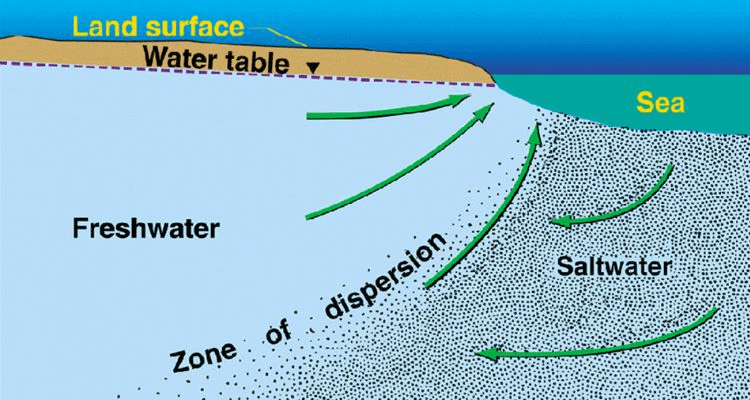
Groundwater flow patterns in a coastal aquifer. Source: California Water Science Center.
NEW WORK
On August 20th, 2024, the U.S. Geological Survey (USGS) published the growing threat of salt water contamination of drinking water in Kings, Queens and Nassau Counties, Long Island, New York:
“Most of Kings and Queens Counties are intruded with saltwater in both the upper glacial-Jameco-Magothy and Lloyd-North Shore aquifers systems. Saltwater increased during the 20th century and continues to increase to the present (2023) in the Lloyd-North Shore aquifer system in Great Neck and Manhasset Neck in northern Nassau County. A major wedge of saltwater intrusion in the upper glacial-Jameco-Magothy aquifer in southwestern Nassau County appears to be increasing.”
The results were based on an analysis dating back to 2016:
“In 2016, the U.S. Geological Survey began a multiyear cooperative study with the New York State Department of Environmental Conservation to evaluate the sustainability of Long Island’s sole-source aquifer system through hydrogeologic mapping, compilation of groundwater chloride concentrations, and groundwater flow modeling. In the initial phase of the islandwide study, the hydrogeologic framework and extent of saltwater intrusion in aquifers in Kings, Queens, and Nassau Counties on western Long Island, N.Y., were investigated. The aquifer system underlying western Long Island has been under stress from pumping of public, irrigation (golf course), and industrial supply wells. Saltwater intrusion has occurred from surrounding embayments (East River, Long Island Sound, Jamaica Bay, and the Atlantic Ocean) due to pumping.”[6]
U.S. ATLANTIC COAST
Circle of Blue, a nonprofit news organization that reports on events surrounding the global freshwater crisis, released a three part article series on saltwater intrusion on the U.S. East Coast entitled: “Saltwater Intrusion, a “Slow Poison” to East Coast Drinking Water.”
Part one covers the effects of saltwater intrusion on freshwater sources along the East Coast.
Holly Michael, director of the Delaware Environmental Institute compared the balance of freshwater on land and sea levels to a seesaw, stating the following:
“It’s a balance between the land and the sea. So if you have enough freshwater on land, then it balances out sea level. But if you take away some of that freshwater by pumping it out, then that upsets the balance and the saltwater starts to move inland.”[7]
Sea level rise however is tipping that seesaw, with states like North Carolina experiencing SLR 3-10 times faster than the global mean.[8]
The main takeaways from this part of the series are the following:
- “Saltwater is creeping inland from Maine to Georgia, with southeastern states experiencing intrusion the fastest. Climate change amplifies the rate of intrusion.
- Adaptation is costly. Treatment plants, water pipelines, and storage facilities can cost cities millions of dollars.
- Prevention is important, too. Irrigating lawns and golf courses can use as much as 60 percent of freshwater resources in coastal towns.”[9]
- https://www.circleofblue.org/2022/world/saltwater-intrusion-a-slow-poison-to-east-coast-drinking-water/
Part two of the series discusses the effects of saltwater intrusion on coastal farms.
Rollen Chalmers, a 61-year-old farmer from South Carolina, was interviewed about his family’s rice farm. He discussed his struggles with his rice paddies’ deteriorating condition due to saltwater intrusion, which had decreased the amount of cropland from 30 acres to 22 acres.[10] Chalmers’ farm is one of many coastal farmsteads along the Atlantic coastline that is experiencing the effects of the saltwater intrusion, which in turn is a side effect of both the rising sea levels in the Atlantic and land subsidence.
The main takeaways of the article are as follows:
- “Saltwater intrusion threatens coastal agriculture on the Delmarva Peninsula and in the Carolinas. Thousands of acres are already unable to be farmed.
- Conservation easements can facilitate a transition of cropland to salt marsh, providing numerous ecosystem services and up to 90% of the market value for farms.
- Despite promising adaptation strategies, sea level rise is projected to drown tens of thousands of acres of farmland within the century.”[11]
- https://www.circleofblue.org/2022/water-climate/fighting-for-inches-in-the-southeasts-struggle-with-salt/
Part three of the series covers the phenomena of saltwater intrusion killing coastal forests and ecosystems, titled “Dead Tree Standing: Saltwater Threatens Coastal Forests and Ecosystem Services”.
Dr. Chris Asaro from the U.S. Department of Agriculture’s Forest Service has been working for several years mapping the growing number of dead trees spreading along the East Coast. Dr. Asaro and other authorities refer to these expanses of dead trees as “ghost forests”.
With sea levels rising up to 5 millimeters per year on the East Coast, “…saltwater is continuously pushing inland as far as 15 feet per year, aided by strong storm events that deposit salt on top of the soil. The result is mass tree death all along the coast, with hotspots in New Jersey, Maryland, and North Carolina.”[12]
The main takeaways from the article are as follows:
- “Sea level rise is causing ghost forests to expand along the east coast, with hotspots in New Jersey, Maryland, and North Carolina.
- Salt marshes are migrating to take the place of wetland forests, causing a transition of ecosystem services. Water quality and quantity will decrease as a result.
- Hundreds of thousands more acres of forests are set to transition to ghost forests by 2100.”[13]
- https://www.circleofblue.org/2022/water-climate/dead-tree-standing-saltwater-threatens-coastal-forests-and-ecosystem-services/
DELAWARE
One state which is under considerable threat from saltwater intrusion is Delaware. With rising sea levels, Delaware’s drinking water supply is at risk of saltwater intrusion which could trigger chemical reactions at contaminated industrial sites. According to the nonprofit news service Spotlight Delaware, “…Saltwater is moving farther north and inland, and while that may mean more immediate impacts for habitats, farmers, and drinking water resources along Delaware’s more southern coasts, it also poses a potential risk for northern Delaware where about 75% of people rely on surface waters for clean drinking water. Research has also shown that contaminated sites may face risk of spreading pollution if they’re impacted by salty floodwaters.”[14]
TEXAS
Increased salinity in water is not just caused by climate change, but also by human actions. Corpus Christi, Texas’ eight-largest city, is experiencing a serious water crisis. The two main reservoirs “…are at historic lows amid a persistent drought and city leaders have told residents they’re less than a year away from major water cuts that could force them to reduce their water use by 25% or face extra fees.”[15]
The city has been scrambling to address the water shortage, with the main effort centering on additional drilling for ground water. Currently, 8 wells are being drilled to supply the city’s water treatment plant with 12 additional wells under construction. However, there are growing concerns about the increased drilling as the aquifers are being drained faster than they can replenish, which is affecting farmers in Nueces County. A group of farmers, gardeners and a retired refinery operator tested one of the city wells and discovered “…dissolved solids — which include minerals like calcium, chloride or sulfates — measured at 3,412 parts per million, levels high enough to damage crops and household plumbing.
When this salty groundwater is discharged into the Nueces River it can raise salinity levels and make the river more brackish.”[16]
The city had planned to build a desalination plant that could turn millions of gallons of seawater into freshwater, but it was cancelled due to cost overruns (going from nearly $760 million to over $12 billion)[17] and alarms from environmental groups that the salty brine pumped into the bay from the plant could harm the local ecosystem.
The city wells are “pulling water out faster than [the aquifer] can recharge,” said Kelly Harlan, the pilot who lives in the area and comes from a long line of farmers.”[18]
LOUISIANA
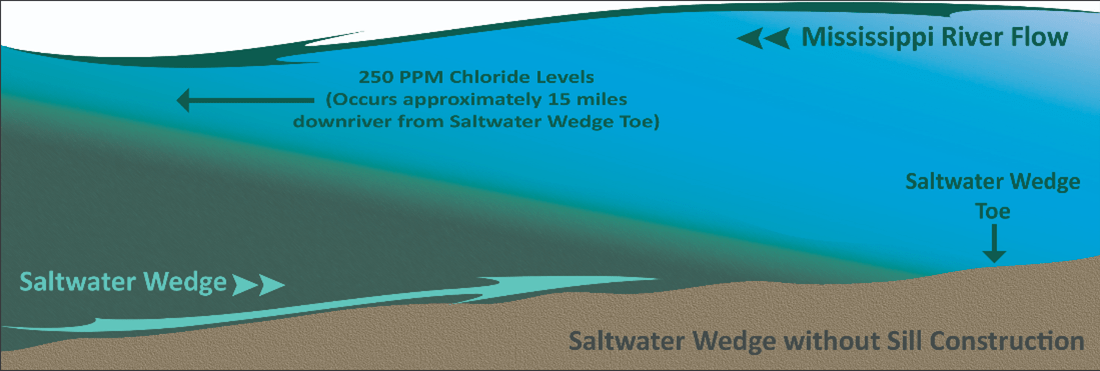
The growing threat of saltwater intrusion is threatening New Orleans and Louisiana.
According to NOLA Ready, the official emergency preparedness campaign for New Orleans:
“Extended drought conditions in the Mississippi River and Ohio River watersheds have brought the River’s flow in south Louisiana to near historic lows. The lack of flow from the river is allowing salty water from the Gulf of Mexico to push its way upriver toward the metro area.
New Orleans at the other regional parishes get our municipal water supply from the river, so if the saltwater reaches our water intakes it will threaten our ability to provide drinkable water.”[19]
With drought causing increasing levels of saltwater intrusion, the Sewerage & Water Board of New Orleans (SWBNO), may see increasing salt levels in the water taken from the Carrollton and Algiers water plants.
A secondary concern is that “…elevated salt content could lead to corrosion of pipes in the water distribution system.”[20]
An example of this concern happened in Flint, Michigan back in 2014:
“…incoming water was not treated properly and led to corrosion of lead pipes throughout the system. This contaminated Flint’s water system with heavy metals such as lead and copper, which left water undrinkable and required a major effort to replace corroded pipes.”[21]
FOOTNOTES
[1] https://www.sciencedirect.com/science/article/pii/S2213305424000043
[2] Ibid.
[3] Ibid.
[4]https://www.eesi.org/articles/view/saltwater-intrusion-a-slow-onset-climate-crisis-jeopardizing-americas-coastal-farms
[5] Ibid.
[6]https://www.usgs.gov/publications/hydrogeologic-framework-and-extent-saltwater-intrusion-kings-queens-and-nassau
[7] https://www.circleofblue.org/2022/world/saltwater-intrusion-a-slow-poison-to-east-coast-drinking-water/
[8] Ibid.
[9] https://www.circleofblue.org/2022/world/saltwater-intrusion-a-slow-poison-to-east-coast-drinking-water/
[10] https://www.circleofblue.org/2022/water-climate/fighting-for-inches-in-the-southeasts-struggle-with-salt/
[11] Ibid.
[12]https://www.circleofblue.org/2022/water-climate/dead-tree-standing-saltwater-threatens-coastal-forests-and-ecosystem-services/
[13] Ibid.
[14]https://spotlightdelaware.org/2025/12/26/how-rising-saltwater-could-unleash-pollutants-in-new-castle-county/
[15]https://www.texastribune.org/2026/01/12/texas-corpus-christi-water-crisis-desalination-plant-wells/#:~:text=After%20killing%20planned%20desalination%20plant,2026%2C%205:00%20a.m.%20Central
[16] Ibid.
[17] Ibid.
[18] Ibid.
[19] https://ready.nola.gov/incident/saltwater-intrusion/about-saltwater-intrusion/
[20] Ibid.
[21] Ibid.