
BY STAS MARGARONIS & KEVIN POLICARPO
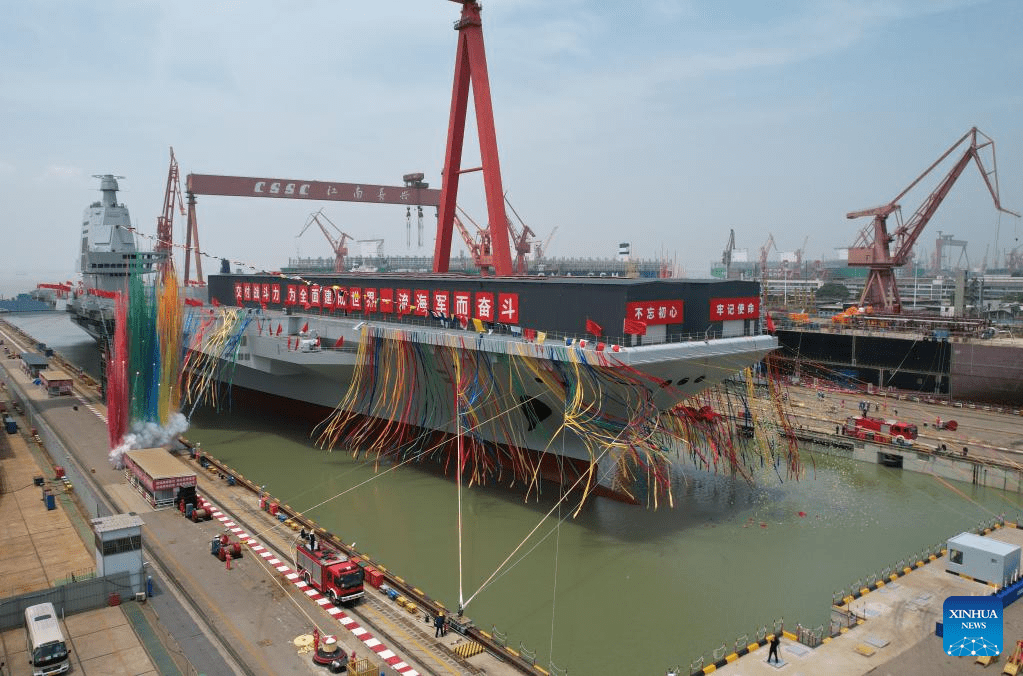
China’s growing naval superiority over the United States is the result of a concerted Chinese commercial and naval shipbuilding effort that the United States and the U.S. Navy chose to ignore while letting its commercial and naval shipbuilding capabilities and shipyards decline or disappear.
SOUTH KOREAN INVESTMENTS
One bright spot is the efforts by the Biden and Trump administrations to encourage Korean shipbuilders to acquire U.S. shipyards and upscale their capabilities.
The $150 billion pledge by South Korea offers the best hope for the United States to partner with a world-class shipbuilder.
However, analysts have expressed skepticism about the feasibility of Seoul’s investment pledge and cautioned that rebuilding America’s shipbuilding capacity would likely be a long and challenging process, according to South Korean news media reports.[1]
Wu Jialu, a chief analyst of industrial research at China International Trust Investment Corporation (CITIC) Futures, told the South China Morning Post (SCMP) that the US$150 billion investment may prompt South Korean shipbuilders to build or acquire shipyards in the U.S., providing talent and technological support.
South Korean firms could help improve the competitiveness of the U.S. shipbuilding industry, particularly in the construction of high-value-added vessels, but reviving the whole industry would still be a protracted process due to supply chain and capacity limitations, she said.
The full impact of the U.S. port fees being assessed by the U.S. Trade Representative (USTR) on Chinese built ships has yet to become clear, and future market trends would also depend on fleet renewal and upgrading demand, Wu told the SCMP.
South Korean President Lee Jae-Myung is quoted as stating that US$150 billion of the promised investment would be dedicated to shipbuilding. The capital would provide “solid support” for South Korean companies entering the U.S. shipbuilding industry, Lee wrote in a Facebook post.[2]
ICE RAID ON HYUNDAI PLANT IN GEORGIA INFURIATES SOUTH KOREANS
However, in early September, U.S. Immigration and Customs Enforcement (ICE) raided a Hyundai battery plant in Georgia and detained a number of South Korean nationals. The raid has had a negative impact in South Korea and could negatively impact Korean investments in the United States, according to a report in The Diplomat:
“The Congressional Research Service pointed out that … ICE’s operations against Hyundai’s Georgia plant ‘have raised concerns in South Korea about the bilateral relationship, as well as questions over whether U.S. immigration policy may conflict with the U.S. objective for increasing U.S. manufacturing jobs through foreign investment.’
Indeed, the Georgia raid instilled fears among South Korean companies with manufacturing projects in the pipeline in the United States. Samsung Electronics has invested about $37 billion for its semiconductor foundry in Texas. SK Hynix’s Indiana plant, worth $3.8 billion, is expected to mass-produce high-bandwidth memory chips for AI by 2028. Weeks before the Georgia raid, Hyundai also pledged to hike its U.S. investment to a total of $26 billion. Besides these megaprojects, there are other major South Korean deals scattered around the U.S.”[3]
While the United States continues to shoot itself in the foot, China continues to move forward.
CHINA BUILDS MOMENTUM
China’s growing dominance in shipbuilding has given it a strategic advantage. China’s decades of maritime development has allowed it to build advanced commercial and naval ships in considerable numbers. By comparison, the U.S. is struggling to fix decades worth of decay in its shipbuilding industry, from manpower shortages, lack of experienced workers, faulty systems, aging infrastructure and production delays.
With the risk of potentially losing the next major naval conflict with China, the U.S. is running out of time to address the necessary steps to address the decay of its shipbuilding industry and build up its naval and maritime fleets in order to maintain the freedom of the seas.
CHINESE NAVAL POWER
Since the early to mid-1990s, China has been working to fulfill its ambitions and become a global power. Key among its goals has been the development of its shipbuilding industry to increase both its commercial fleet and its Navy.
According to the Center for Strategic and International Studies (CSIS) Are U.S. Policies Eroding China’s Dominance in Shipbuilding:
“In 2024, China captured over 53 percent of global market share in the commercial shipbuilding industry, while the United States accounted for only 0.1 percent. Just one Chinese firm, the state-owned juggernaut China State Shipbuilding Corporation (CSSC), built more commercial vessels by tonnage in 2024 than the entire U.S. shipbuilding industry has built since the end of World War II.”[4]
A United States Naval Institute article from February 2024 stated that in terms of global shipbuilding, China is the largest shipbuilder with a majority of the global market “…with South Korea second at 29.24 percent, and Japan third with 17.25 percent. The United States has a relatively insignificant capacity at 0.13 percent.”[5]
For its shipbuilding industry, China operates 20 large shipyards for building military and commercial vessels, 140 dry docks to allow for scaling up ship production and a massive maintenance and damage repair capability.[6]
A 2024, report issued by the Center for Strategic and International Studies (CSIS) focused on the People’s Liberation Army Navy (PLAN) and described how China now surpasses the U.S. Navy and now possesses the world’s largest maritime fighting force. The report stated that in 2024, China operated 234 warships compared to the U.S. Navy’s 219 and operates 167 logistics ships compared to the 126 in U.S. service.[7] These numbers allow the PLAN more warships to carry out offensive operations and having more logistics ships means they can move more personnel and material across the Pacific.
The report also noted the age gap between U.S. and Chinese warships. About 70% of China’s warships were launched after 2010, compared to the U.S. Navy’s 25% in the same time period.[8]
The Commander of U.S. Indo-Pacific Command (USINDOPACOM), Admiral Samuel Paparo spoke at a Senate Armed Services Committee hearing. Paparo spoke about the challenges facing his command in the region and China’s ability to produce military assets. Among his points was that China was “…building naval combatants at the rate of 6 to 1.8 to the US, roughly three times as many warships,” quoted by a Business Insider report dated April 18th, 2025.[9]
U.S. SHIPBUILDING WOES GET WORSE
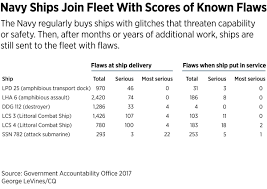
Compared to China’s shipbuilding boom and dominance, U.S. shipbuilding has been declining and encountering setback after setback.
One of the major compilations for U.S. shipbuilding has been the massive backlog of ships that require maintenance. According to the Government Accountability Office (GAO) in their report titled Shipbuilding and Repair (published in February 2025):
“Since 2004, the Navy has nearly doubled its shipbuilding budget, after adjusting for inflation. At the same time, the Navy has accrued a backlog of surface ship maintenance— which reached $2.3 billion in deferred work by August 2022—that influenced it to propose retiring some ships early.”[10]
With the current capacity of U.S. shipyards, the Navy is estimated to be 20 years behind on maintenance of their ships. (emphasis added)[11]
The U.S. Navy relies on private companies as a key element of its industrial base to build and repair its fleet. However, the shipyards have been experiencing a “boom and bust” period. Over the past 50 years, 17 private shipyards were closed down or departed the defense industry.[12] As of 2021, there remains “…roughly 25 shipyards in the United States constructing medium- to large-sized vessels. Seven of these shipyards construct Navy battle force ships.”[13]
Additional problems facing the Navy include a reduction of the Navy’s in-house naval architecture and engineering staff which shrank from around 1,200 to 300 personnel.[14] Then there was the use of unreliable systems and subsystems on ships that were pushed into production before they were properly tested. These were the reasons as to the design and production issues with the failed Zumwalt-class destroyers and the littoral combat ships as well as the issues and delays “… with the Gerald R. Ford-class aircraft carriers, San Antonio- and America-class amphibious ships, and Virginia-class submarines.”[15]
The February 2025 GAO report noted the following struggles for U.S. shipbuilding:
- “Shipbuilding
- Infrastructure
- Aging infrastructure
- Lack of physical space in shipyard
- Workforce
- Insufficient number of workers to meet demand
- Recruitment and retention problems
- Inexperienced staff
- Ship repair
- Infrastructure
- Not enough capacity for unplanned work, like emergent repairs
- Workforce
- Repair workload could exceed workforce capacity in certain fleet concentration areas, resulting in work that may be shifted to other locations”[16]
- Infrastructure
- Infrastructure
US Trade Representative Proposed Fees On Chinese Ships Could Cause Market Decline
As the U.S. works to solve its shipbuilding woes, there has also been a push to curb China’s shipbuilding lead. Port fees proposed by the U.S. Trade Representative (USTR) to go into effect on October 14th: “…ships built in China – or operated or owned by Chinese entities – will need to pay a fee at their first port of call in the United States.”[17]
According to GCaptain, analyst estimates are that the fees “…could top $1 million for a ship carrying more than 10,000 containers and is slated to rise annually through 2028…”[18]
As a result of the USTR announcement, Chinese shipbuilding orders have begun to decline, according a 2025 CSIS report:
“China’s share of all new orders by volume fell below 50 percent in January, its lowest monthly reading since September 2023. Notably, the collapse of orders at Chinese yards began before the USTR’s investigation was complete, suggesting that the market was already cooling off, likely due to capacity constraints and glutted order books after the surge in orders in the preceding months.
Purchases of Chinese-built ships plunged further after the USTR’s February 2025 determination that China had employed nonmarket practices, and its announcement of a series of proposed remedies, including a new docking fee regime targeted at penalizing shipping firms that operate Chinese-built vessels.
Between March and May 2025, Chinese shipyards accounted for less than 30 percent of new orders, reflecting a dramatic slowdown in new purchases as companies assessed the impacts of the USTR’s proposed actions and broader ongoing disruptions to global trade.
Notably, orders at non-Chinese yards—mostly in Japan and South Korea—stayed roughly consistent with their normal rates during this period, suggesting that the drop in order volume was concentrated in China rather than reflecting a collapse in overall global demand. This provides additional evidence that the USTR’s impending penalties on companies operating Chinese-built ships were likely a significant factor, beyond expected cyclical volatility and uncertainty caused by the Trump administration’s tariff-driven disruption to the global economy.”[19]
However, global shipping companies are still ordering commercial vessels from Chinese shipyards. According to another CSIS report:“Over 75 percent of new tonnage ordered globally in the second half of 2024 went to Chinese yards.”[20]
FOOTNOTES
[1]https://www.koreatimes.co.kr/business/companies/20250731/make-american-shipbuilding-great-again-project-touted-as-key-contributor-to-tariff-deal
[2]https://www.scmp.com/economy/china-economy/article/3320297/behind-trumps-south-korea-deal-plan-transform-global-shipbuilding
[3] https://thediplomat.com/2025/09/south-korea-us-relations-suffer-the-aftermath-of-ices-georgia-raid/
[4]https://www.csis.org/analysis/are-us-policies-eroding-chinas-dominance-shipbuilding
[5]https://www.usni.org/magazines/proceedings/2024/february/united-states-must-improve-its-shipbuilding-capacity
[6] Ibid.
[7] https://www.csis.org/analysis/unpacking-chinas-naval-buildup
[8] Ibid.
[9] https://www.businessinsider.com/china-outpacing-us-shipbuilding-top-indopacom-admiral-says-2025-4
[10] https://www.gao.gov/assets/gao-25-106286.pdf
[11]https://www.usni.org/magazines/proceedings/2024/february/united-states-must-improve-its-shipbuilding-capacity
[12] https://www.gao.gov/assets/gao-25-106286.pdf
[13] Ibid.
[14]https://www.usni.org/magazines/proceedings/2024/february/united-states-must-improve-its-shipbuilding-capacity
[15] Ibid.
[16] https://www.gao.gov/assets/gao-25-106286.pdf
[17] CSIS: China Still Dominates Ship Orders Despite U.S. Port Fee Push
[18] Ibid.
[19] https://www.csis.org/analysis/are-us-policies-eroding-chinas-dominance-shipbuilding
[20] Ibid.
BIBLIOGRAPHY:
https://prospect.org/blogs-and-newsletters/tap/2025-01-17-how-china-dominates-global-shipbuilding/
https://news.usni.org/2025/05/01/report-to-congress-on-chinese-naval-modernization-21
https://www.gao.gov/products/gao-25-106286
https://www.csis.org/analysis/are-us-policies-eroding-chinas-dominance-shipbuilding
https://www.csis.org/analysis/unpacking-chinas-naval-buildup
Are U.S. Policies Eroding China’s Dominance in Shipbuilding?
https://thediplomat.com/2025/09/south-korea-us-relations-suffer-the-aftermath-of-ices-georgia-raid/