
BY KEVIN POLICARPO
More than 5,500 hazardous sites across the U.S. are projected to be at risk of coastal flooding by 2100, according to a University of California Los Angeles (UCLA) research team report.[1]
Oil and gas wells and industrial facilities that emit quantities of hazardous substances make up the largest proportion of contaminated sites, the report said:
“Oil and gas wells and industrial facilities that emit quantities of hazardous substances that require reporting to the U.S. Environmental Protection Agency’s Toxic Release Inventory (hereafter “TRI sites”) make up the largest proportion of sites we considered and sites at risk. Under the high emissions scenario, over a fifth of coastal sewage treatment facilities, refineries and formerly used defense sites, roughly a third of power plants, and over 40% fossil fuel ports and terminals are projected to be at risk by 2100.”[2]
The UCLA report detailed the risk of hazardous industrial sites on the U.S. coastline from flooding caused by sea level rise: “We identify 5500 facilities at risk of a 1-in-100-year flood event by 2100 under a scenario of continued high greenhouse gas emissions, including coastal power plants, sewage treatment facilities, fossil fuel infrastructure, industrial facilities, and formerly used defense sites.”[3]
The team assess the annual probability of floods exceeding the land elevation of over 47,646 coastal hazardous site locations and considered sites that were below 18 meters above mean higher high-water lines across the U.S. coastline and those that were under threat from a 1-in-100-year flood event.
The team made the following discovery:
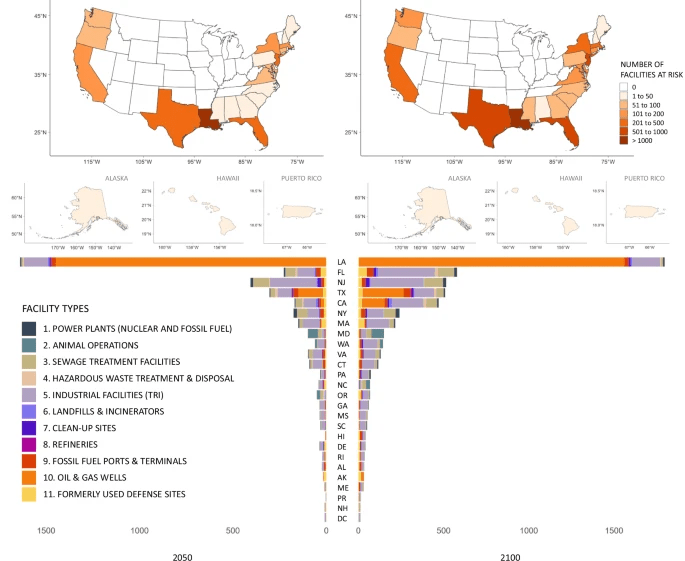
“We found that over 11% of coastal sites in our analysis are at risk of SLR-related flooding by 2100 under the high emissions scenario. Figure 1 shows the distribution of at-risk sites by state or territory under RCP 8.5 in 2050 and 2100. Seven states (Louisiana, Florida, New Jersey, Texas, California, New York, and Massachusetts) account for nearly 80% of projected at-risk sites in 2100.
Restricting greenhouse gas emissions to the low emissions scenario makes little difference in terms of the number of projected sites at risk in the near term (2050) but would reduce the number of at-risk sites from 5500 to 5138 (a reduction of 362 or 7% of sites) in the long term (2100).”[4]
For more information, please see: https://www.nature.com/articles/s41467-025-65168-2
SITE MAP
Number of sites at risk of flooding due to sea level rise in (left) 2050 and (right) 2100 under a high emissions scenario (RCP 8.5) by state and type.
The team discovered that if climate change continues to worsen, flooding will cause the hazardous sites to release pollutants such as oil and gas, sewage, toxic waste and other such materials into the water.
The report was peer-reviewed and published by the London-based scientific journal Nature Communications on November 20th, 2025.
COASTAL & GULF COAST SUBSIDENCE WORSENS SEA LEVEL IMPACT
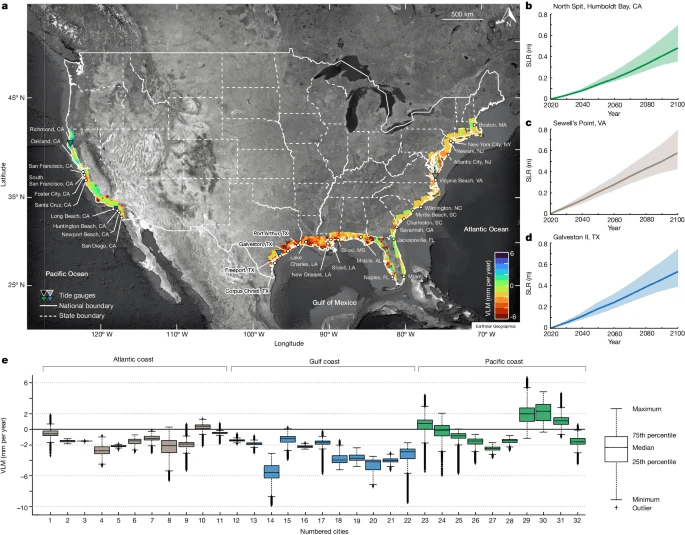
Compounding the situation is that U.S. coastlines are experiencing land subsidence according to a 2024 study produced by Virginia Tech. The study found that 32 U.S. coastal cities were experiencing land subsidence which only exacerbate the effects of sea level rise:
“The sea level along the US coastlines is projected to rise by 0.25–0.3 m by 2050, increasing the probability of more destructive flooding and inundation in major cities. However, these impacts may be exacerbated by coastal subsidence—the sinking of coastal land areas—a factor that is often underrepresented in coastal-management policies and long-term urban planning. In this study, we combine high-resolution vertical land motion (that is, raising or lowering of land) and elevation datasets with projections of sea-level rise to quantify the potential inundated areas in 32 major US coastal cities.
Here we show that, even when considering the current coastal-defence structures, further land area of between 1,006 and 1,389 km2 is threatened by relative sea-level rise by 2050, posing a threat to a population of 55,000–273,000 people and 31,000–171,000 properties.”[5]
Furthermore the report says: “Furthermore, coastal cities often experience sinking land (so-called land subsidence), whose compounding effect contributes to relative SLR, exacerbating coastal hazards and risks.”[6]
Socioeconomic losses will be severe: “On the coasts of the conterminous USA, climate-induced sea levels are rising faster than the global average, with an expected increase over the next few decades. Owing to its geography and population distribution, the USA is a coastal nation, with more than 30% of its population residing in coastal cities, generating an estimated annual revenue of US$3.8 trillion. Consequently, socioeconomic losses from climate-induced SLR will represent a notable facet of climate-change consequences in the USA. In the short term (one to three decades), only continued observed rises in sea level are sufficient to trigger cascading hazards across US coastal regions, with a projected increase in the frequency and intensity of storm surges, saltwater intrusion, high-tide flooding and coastal erosion.”[7]
For more information, please see: https://www.nature.com/articles/s41586-024-07038-3
COASTAL HAZARDS ACROSS THE USA
The Virginia Tech research team also discovered that of the 32 cities experiencing land subsidence, 24 of them are experiencing subsidence rates of over 2 millimeters per year:
“We find subsidence rates greater than 2 mm per year in 24 out of 32 major cities along the US Atlantic, Gulf and Pacific coasts, with notable subsidence rates (>5 mm per year) in cities such as Charleston (city number 8), Biloxi (city number 14), Galveston (city number 20) and Corpus Christi (city number 22). On the US Pacific coast, we observe lower rates of land subsidence compared with the Atlantic and Gulf coasts, with some cities characterized by marked uplift (such as Richmond: city number 23; Long Beach: city number 29; Huntington Beach: city number 30; and Newport Beach: city number 31).”[8]
FOOTNOTES
[1] https://www.nature.com/articles/s41467-025-65168-2
[2] Ibid.
[3] Ibid.
[4] Ibid.
[5] https://www.nature.com/articles/s41586-024-07038-3
[6] Ibid.
[7] Ibid.