
Photo: Royal IHC
By Stas Margaronis
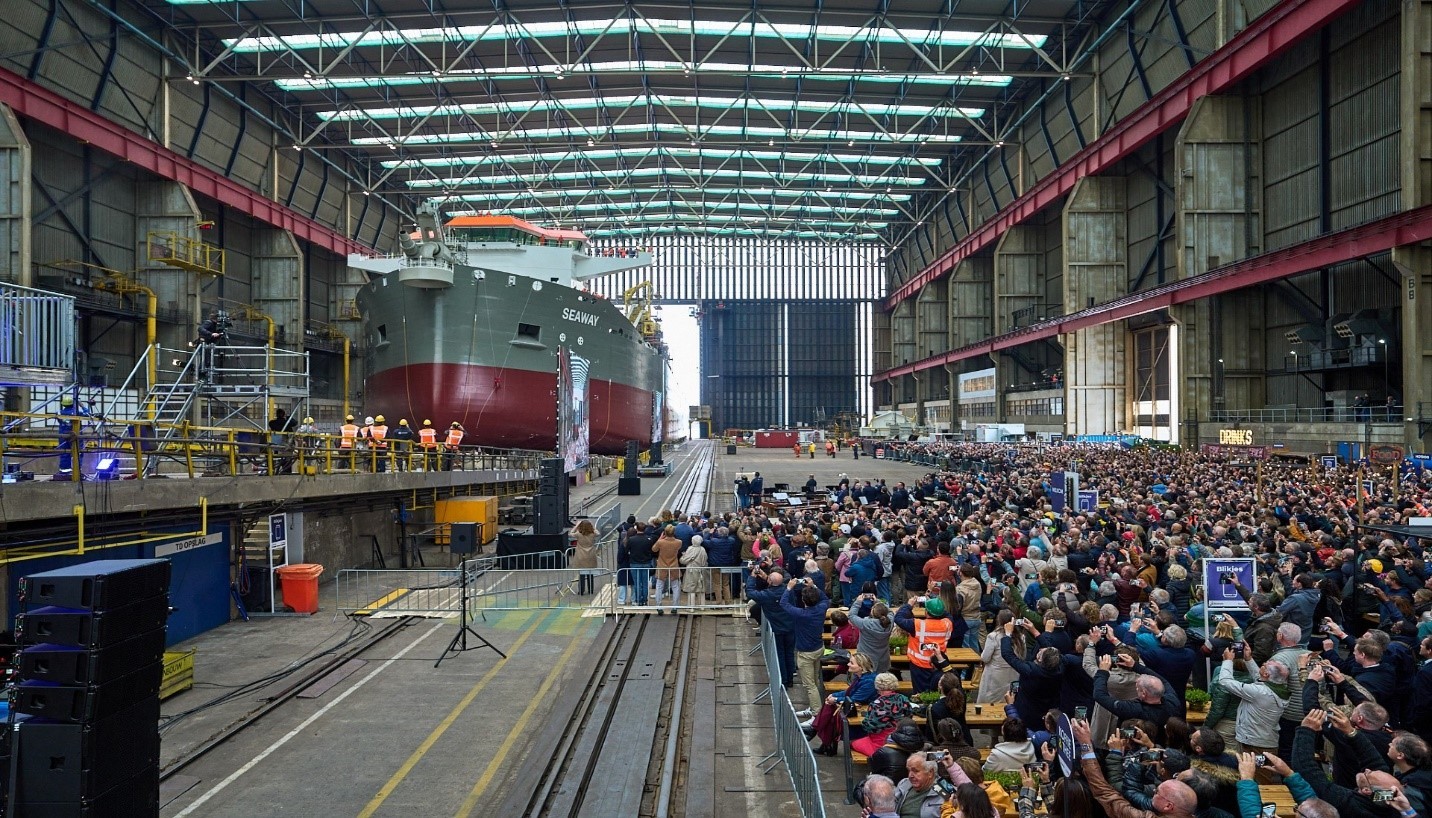
Last October, 2,000 Boskalis employees working for the Dutch dredging company and Royal IHC workers employed by the Dutch shipbuilder, attended the launching of the SEAWAY: a next-generation trailing suction hopper dredger.
The SEAWAY was launched at Royal IHC’s yard in Krimpen aan den IJssel, outside of Rotterdam at an indoor shipyard (see photo).
Royal IHC’s indoor shipyard provides the builder with an all-weather capability while concentrating construction logistics in an enclosed framework that can reduce manhours. It offers some insights for new shipbuilding strategies for the United States (see photo)
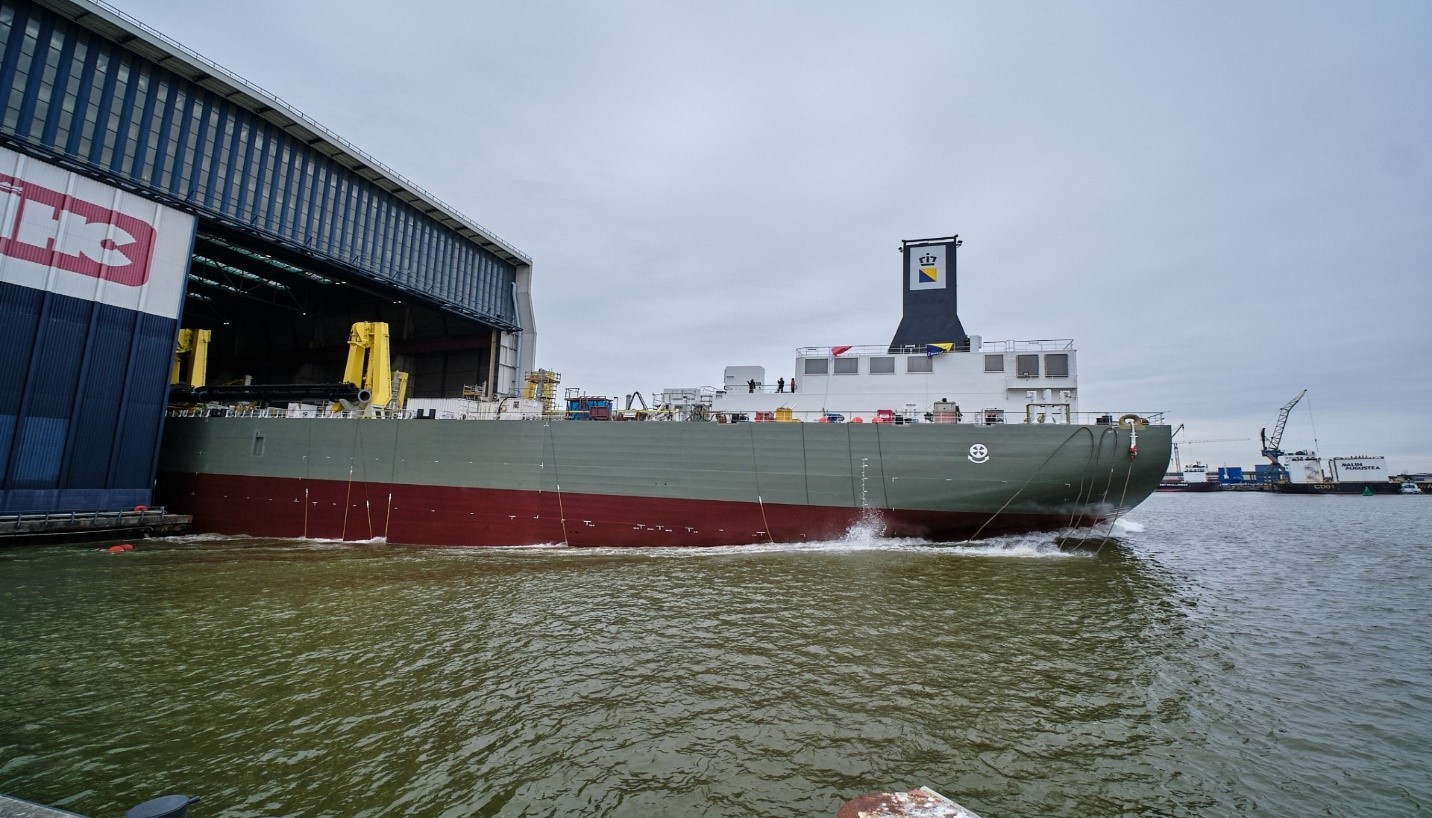
Photo: Royal IHC
The technical expertise of the vessel also provides for a template for advanced dredging technology being deployed by Dutch dredging companies.
According to Royal IHC: “With an impressive length of 178 meters (584 feet), a width of 38 meters (125 feet), and a hopper capacity of 31,000 cubic meters (40,546 cubic yards) which the company says is equivalent to more than 2,000 truckloads of sand.
The SEAWAY is one of the largest dredgers of its kind in the world. Designed and built by Royal IHC for Boskalis, “this state-of-the-art vessel is set to play a key role in making dredging operations more sustainable.”
Built for the Future
IHC says the SEAWAY has three major attributes:
- Equipped with a full diesel-electric installation, Azipods™ propulsion, an optimized hull design and advanced automation systems, the vessel is designed to set new standards in efficiency, maneuverability, and environmental performance when she enters service.[1]
- The SEAWAY is the result of close “collaboration between Boskalis and Royal IHC, combining decades of dredging expertise with cutting-edge shipbuilding technology. Its unique design allows for a longer cargo hold, improving capacity while maintaining agility.”
- The SEAWAY will “operate on (green) methanol as an alternative fuel,” which represents a major step forward in sustainable marine engineering.
IHC says the SEAWAY is undergoing “final outfitting and extensive testing before her first deployment overseas. Meanwhile, her future crew is already in training — including simulator sessions — to prepare for this groundbreaking new vessel.”
Trailing Suction Hopper Dredgers
The trailing suction hopper dredgers (TSHDs) of Boskalis are oceangoing vessels that can collect sand and silt from the seabed and transport it over large distances. Boskalis deploys trailing suction hopper dredgers for the construction and maintenance of ports and waterways as well as land reclamation and coastal defense and riverbank protection.
Trailing suction hopper dredgers are equipped with one or two suction pipes ending in drag heads. The drag head moves slowly over the bed collecting the sand like a giant vacuum cleaner. The mixture of sand and water is pumped into the hopper of the dredging vessel. Excess water flows out through so-called overflows. Dredging stops when the maximum hopper capacity is reached.
The vessel can discharge its load in various ways, depending on the project specifications.
One method used is rainbowing. Rainbowing is used when the vessel can get close to the discharge location and the previously reclaimed sand body is above or almost above the surface. The sand is sprayed through a nozzle in the bow rainbowing in an arch through the air.
Another discharge method consists of pumping the sand ashore by floating or sunken pipelines. This approach is used for example in land reclamation or coastal protection projects. The sand is pumped through floating pipelines into the reclamation area.
The sand can also be deposited through doors located in the bottom of the vessel.
Boskalis has around 21 trailing suction hopper dredgers, including two of the world’s largest, the Queen of the Netherlands and the Fairway.
Functions
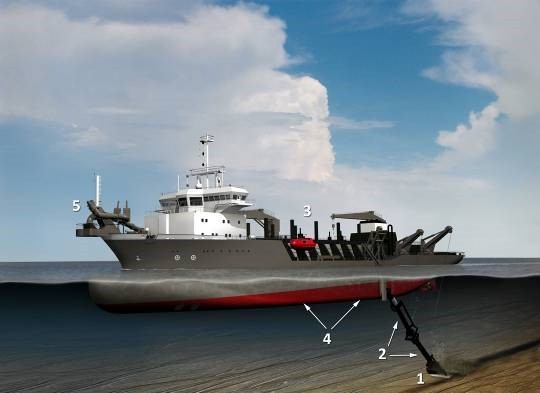
Photo: Boskalis
Boskalis illustrated the functions of the trailing suction hopper dredger in the adjoining illustration. This is a vessel used to extract and transport sand or sediment by dragging a trailing head attached to a long suction pipe (2) with water jets (1) while travelling over the seabed, as a result of which the material to be dredged is loosened in front of the suction head. Large centrifugal pumps transport the dredged material to the hopper (3) from where it is later deposited (through bottom doors) (4) or discharged (through a pipeline or sprayed – rainbowed – across the bow) (5) to a reclamation area. Applications of the hopper dredger include the deepening and maintenance of ports and waterways and protecting coastlines from erosion and the effects of climate change.
FOOTNOTE
[1] https://www.royalihc.com/news/launch-seaway