
BY KEVIN POLICARPO
The boom in data center construction, enabling AI, is running into growing opposition from Americans concerned about higher electricity bills. That in turn is challenging the Trump administration to relieve the data centers’ pressure on higher electricity bills.
Trump’s Solution for Data Centers Is Questioned
In his State of the Union address, President Donald Trump promised that major tech companies would pay for their own electricity and not force consumers to subsidize them:
“Tonight, I’m pleased to announce that I have negotiated the new rate payer protection pledge. You know what that is? We’re telling the major tech companies that they have the obligation to provide for their own power needs… We have an old grid. It could never handle the kind of numbers, the amount of electricity that’s needed. So I’m telling them, they can build their own plant. They’re going to produce their own electricity.…”[1]
This pledge has been received with skepticism, according to a Politico report which said that “President Donald Trump’s newly released plan to shield voters from rising electricity costs tied to the data center boom faces a host of questions — most fundamentally: Does it have any chance of working?”[2]
The report says “Reasons exist to doubt it will, especially given the pledge’s language is nonbinding.”[3]
Politico argued that there were three key issues to understand about the plan, as Trump and other Republicans face growing attacks from Democrats about the rising costs of energy:
- What exactly is this pledge? The “ratepayer protection pledge” signed by Google, Microsoft, Meta, Oracle, xAI, OpenAI and Amazon is meant to ensure residents don’t pay for the electricity used to power data centers. The companies agreed to build, provide or buy any power their data center infrastructure needs.By having tech companies front these costs, Trump said , Americans will avoid increased energy prices — and in fact, these prices could drop “very substantially.” In turn, Trump said, the government will speed up the process for approving power plants, issuing permits within two to four weeks. However, states — not the federal government — are primarily responsible for approving the development of electricity generation.
- How binding is it? Politico said the White House said it expects companies to voluntarily abide by the language to ensure approval of future projects: “The voluntary nature of the pledge is a shift from Trump’s rhetoric during an event in Corpus Christi, Texas where he said the deal would be ‘mandatory.’The lack of any mandatory requirements was already a concern immediately after Trump unveiled the pledges during his State of the Union address last week. State and federal lawmakers on both sides of the aisle said they fear the effort won’t lead to meaningful change unless a judge can enforce it.”[4]
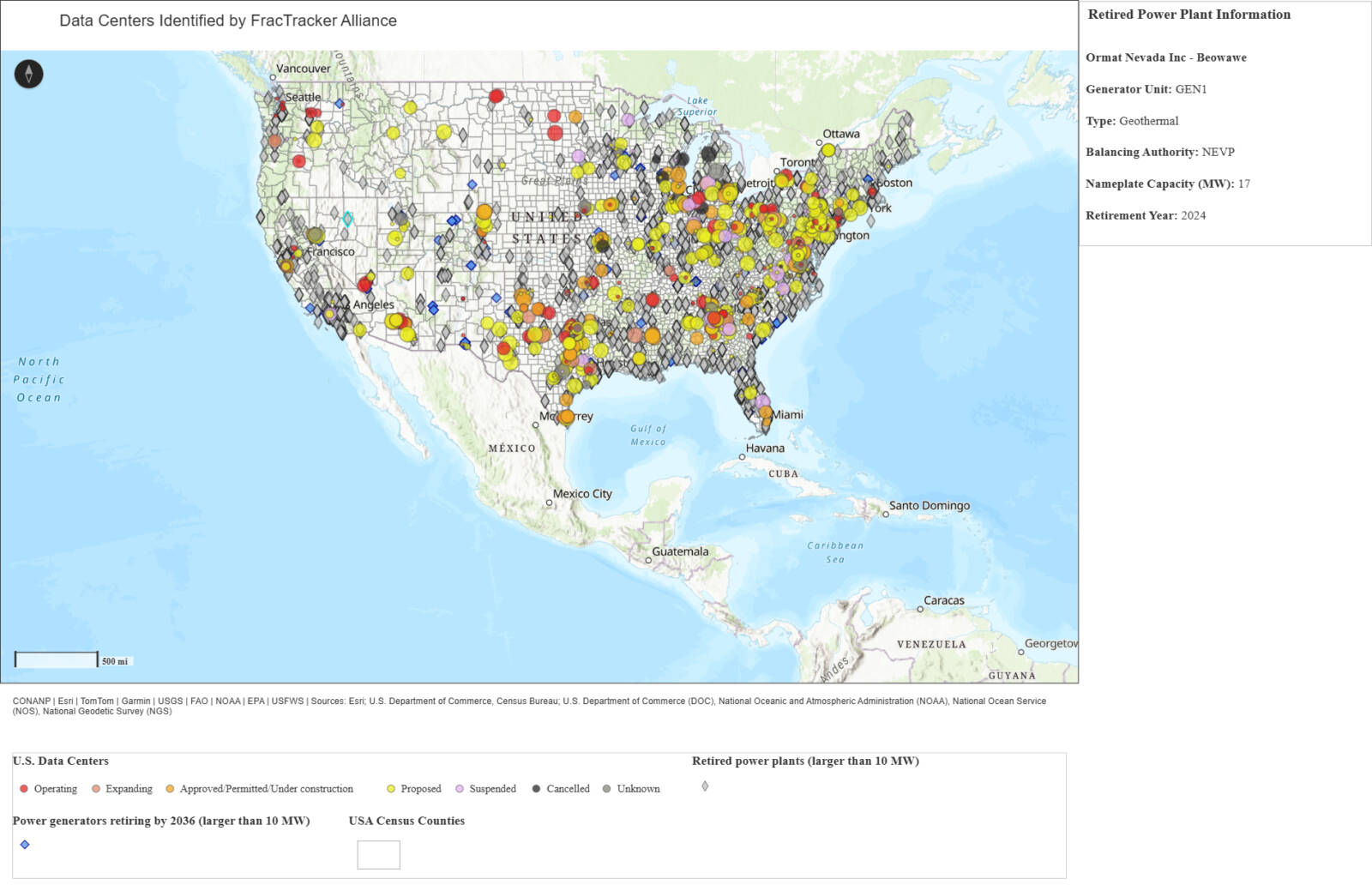
- Will this really do what Trump is promising?: Politico said that this was complicated because: “Trump is running into the unprecedented scale of the AI data center boom, which is raising the costs of everything that goes into the energy infrastructure. Nearly 680 data centers are being planned in the United States, according to the data firm Cleanview, some of them requiring as much electricity as a small or mid-sized city. The Electric Power Research Institute has estimated that data centers could require 9 percent to 17 percent of U.S. electric power by 2030, compared with a 4 to 5 percent share today. While the seven tech companies have the financial strength to make the commitment, it remains to be seen how far the pledge extends across the entire data center development universe, and whether the manufacturers of power plants can match the unprecedented demands for new power.“We have seen transmission rates increase over the last few years, almost across the entire country, and that is a major part of the story,” said Johns Hopkins University researcher Abe Silverman … Michael Jacobs, senior manager for climate and energy at the Union of Concerned Scientists, has estimated that in seven of the 13 Eastern states served by the PJM Interconnection’s high-voltage network of power lines, ratepayers will be charged at least $3.1 billion for grid expansions serving data centers, based on PJM’s 2025 spending plan. “For 2025, Illinois gets a $637 million bill. Pennsylvania gets a $647 million bill. And it looks like Virginia gets a $1.4 billion bill,” Jacobs said. “And I’m just talking about seven states in PJM.”[5]
However, investor-owned utilities are having talks with state politicians about rising rates and additional investments.
According to a February 27th, 2026 Heatmap article, utilities have requested rate increases, with the companies receiving a total of $31 billion back in 2025 which is double the amount requested the previous year.[6] Simultaneously, “… those rate increases have helped push electricity prices up over 6% in the last year, while overall prices rose just 2.4%.”[7] These increased rates have caught public attention, with politicians scrambling to respond in order to prevent or lessen any backlash that could impact their current positions.
Arguably the largest argument for the opposition is the concern of rising utility costs and the lack of power from the U.S. power grid for the data centers to draw upon.
Widening Power Gap
Across the U.S., utility power demand from the data centers will increase to 82.3 gigawatts (GW) in 2026 to power cooling systems, lighting, IT equipment, etc. This increase, according to S&P Global’s market research group 451 Research, will be “… up 28% from 2025 and more than double the demand from three years ago…”[8]
The power gap is also growing at the state level. For example, Virginia’s data center projects will require up to “… 16.6 GW of grid power in 2026, up from 13 GW in 2025 and quadrupling from 2020, according to 451 Research, which expects the state’s data center fleet to need more than 33 GW by 2030 — exceeding demand from all US data centers just four years ago.”[9] Another example is Texas, which 451 Research expects to have a grid power demand of 13 GW in 2026 and continually increase up to 28 GW by 2030.[10]
A February 24th, 2026 report from the Environmental and Energy Study Institute (EESI), a nonprofit organization that promotes environmental sustainability and energy efficiency further outlines the power gap, with the following key takeaways:
- “As data centers expand nationwide, utilities are receiving hundreds of gigawatts in interconnection requests, necessitating significant infrastructure investments.
- Natural gas power plants are being built and existing coal power plants are being propped up to meet the surging demand from data centers.
- Electricity bills are spiking for many households, contributing to an affordability crisis, particularly for the most vulnerable communities.”[11]
The data centers are requesting “…at least 700 gigawatts (GW) of power connection development in 2025, which is more than the 477 GW in electricity that the United States consumed in all of 2023.”[12]
The need for more energy and the growing opposition to the data centers is causing concerns for the overall outlook of the U.S.’s effort in the A.I. race.
Data Center Project Outlook
With the current state of opposition and the data center projects that have been cancelled or delayed, the 2026 outlook for data center growth is not wholly positive.
Sightline Climate, a market intelligence platform, which covers the potential impacts on data center project capacity, released a quarterly report which stated the following:
“We’re tracking 190GW across 777 large data centers and AI factories (>50MW) announced since 2024. At least 16GW of capacity is slated to come online in 2026 across roughly 140 projects. Yet only about 5GW is currently under construction. Around 11GW remains in the announced stage with no visible construction progress, despite typical build timelines of 12–18 months.
Projected delivery dates are getting harder to trust. In 2025, 26% of expected capacity slipped, and another 10% of projects pushed back their commercial operation dates without much notice.
Given that track record, it wouldn’t be surprising if 30–50% of the capacity slated for 2026 ends up delayed.”[13]
With the gap in power and concerns about the increasing costs of utilities, opposition to the data center projects is growing across the nation and have even scored some victories.
Data Center Construction Hampered as Opposition Grows
Data Center Watch, a research firm tracking the growing opposition to data center development, detailed the effects of opposition groups on the U.S. data center pipeline in the second quarter of 2025 and was expanded in S&P Global’s January 2026 report.
The report noted that opposition groups caused 66% of 30 data center projects (20 in total) to be cancelled or delayed, which represents an estimated $100 billion in investments.[14] The report also stated that community opposition groups had grown to a total of 188 groups nationwide.[15]
While the main reason for the opposition comes from concerns about increasing utility costs, there are additional reasons.
Some of these reasons are noted in a February 17th, 2026 article published by The New Republic:
“Some want to protect their grids and water supplies. Others fear data centers will push up energy bills, stress the electrical grid, and use up land that would be better preserved for nature conservation or farming. Then there’s more general rage at the tech oligarchs, as well as terror of the impending dystopia of AI—from job loss to Hollywood visions of malevolent machines that prioritize their own survival over ours.”[16]
The opposition’s arguments are reinforced by the potential impacts to local economies and the environment.
Environmental and Economic Impact of Data Centers
A.I. data centers require cooling systems to operate, usually using water to remove heat from A.I. chips. EESI noted the following for data center water usage:
“A medium-sized data center can consume up to roughly 110 million gallons of water per year for cooling purposes, equivalent to the annual water usage of approximately 1,000 households. Larger data centers can each “drink” up to 5 million gallons per day, or about 1.8 billion annually, usage equivalent to a town of 10,000 to 50,000 people. Together, the nation’s 5,426 data centers consume billions of gallons of water annually. One report estimated that U.S. data centers consume 449 million gallons of water per day and 163.7 billion gallons annually (as of 2021).”[17]
While tech companies claim that building the data centers will create more jobs for nearby communities, the actual number of permanent jobs will be far less. A 2017 report from the U.S. Chamber of Commerce stated the following:
“While being built, a typical data center employs 1,688 local workers, provides $77.7 million in wages for those workers, produces $243.5 million in output along the local economy’s supply chain, and generates $9.9 million in revenue for state and local governments …
However: “Every year thereafter, that same data center supports 157 local jobs paying $7.8 million in wages, injecting $32.5 million into the local economy, and generating $1.1 million in revenue to state and local governments.”[18]
FOOTNOTES
[1]https://www.reuters.com/business/energy/trump-says-he-has-told-big-tech-companies-build-their-own-power-plants-2026-02-25/
[2] https://www.politico.com/news/2026/03/04/trump-ai-data-centers-electricity-00811909
[3] Ibid.
[4] Ibid.
[5] Ibid.
[6]https://heatmap.news/energy/utilities-affordability?utm_campaign=heatmap_daily_free&utm_medium=email&_hsenc=p2ANqtz-_Z5qPPo2ocrK-XUrhVvtxl2bnQgepUZz8geSp398mc9f-ztN3e3Bno8jrj30uX4QJcIFp34BV4X3bfT09msIJ-FYK1Og&_hsmi=406143509&utm_content=406143509&utm_source=hs_email
[7]Ibid.
[8]https://www.spglobal.com/energy/en/news-research/latest-news/electric-power/012926-data-center-opposition-gains-momentum-as-power-demand-spikes
[9] Ibid.
[10] Ibid.
[11] https://www.eesi.org/articles/view/data-center-power-demands-are-contributing-to-higher-energy-bills
[12] Ibid.
[13] https://www.sightlineclimate.com/research/data-center-outlook
[14]https://www.spglobal.com/energy/en/news-research/latest-news/electric-power/012926-data-center-opposition-gains-momentum-as-power-demand-spikes
[15] https://www.datacenterwatch.org/q22025
[16] https://newrepublic.com/article/206633/data-centers-ai-big-tech-opposition
[17] https://www.eesi.org/articles/view/data-centers-and-water-consumption
[18] https://www.uschamber.com/technology/data-centers-jobs-opportunities-communities-nationwide