
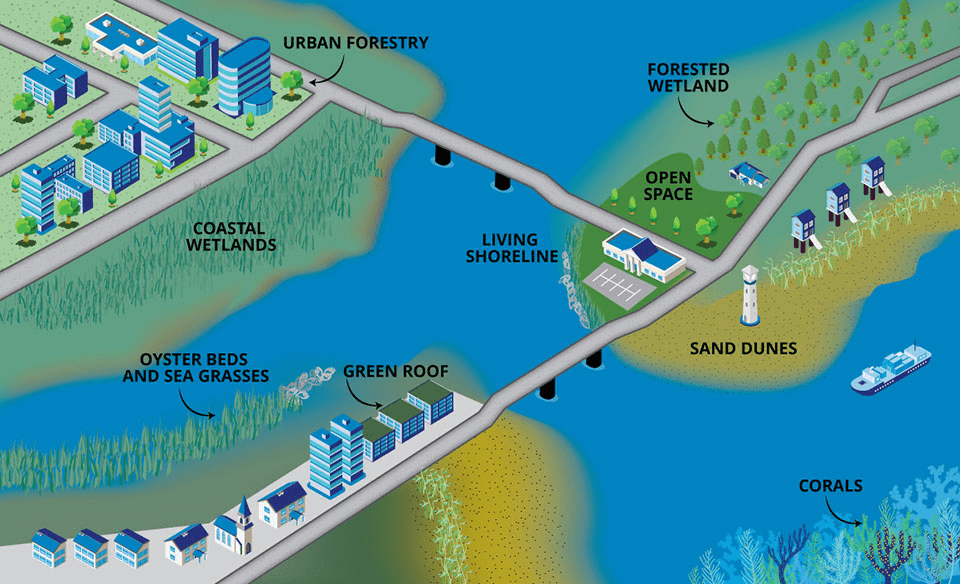
SOURCE: NOAA
By Kevin Policarpo, RBTUS
What are ‘sponge cities’ and how can they prevent floods?
Sponge cities are “…urban areas with abundant natural areas such as trees, lakes and parks or other good design intended to absorb rain and prevent flooding.”[1] A benefit of these cities is that they can hold more water in rivers, plants and soil, which make them more resilient to droughts. According to global design firm Arup and the World Economic Forum, “Natural ways to absorb urban water are about 50% more affordable than man-made solutions, and are 28% more effective…”[2]
A recent study using artificial intelligence ranked seven major cities on the amount of natural space that can absorb rainwater (aka their ‘sponginess’). The seven cities selected “…were New York, London, Singapore, Mumbai, Auckland, Shanghai, and Nairobi.”[3]
The sponginess of the cities are ranked as follows:
- Auckland, New Zealand (35%)
- Nairobi (34%)
- New York City, Singapore, Mumbai (30%)
- Shanghai (28%)
- London (22%)[4]
As interest in utilizing “nature-based solutions” has grown in popularity in recent years, coastal cities such as New York and Shanghai are embracing their ‘sponginess” by building inner-city gardens, improving their river drainage and plant-edge sidewalks.
https://www.weforum.org/stories/2022/03/sponge-cities-nature-tackle-climate-floods-urban/
What on earth are sponge cities?
According to a 2022 study, 1.8 billion people are affected by flood risk, which will be exasperated by worsening climate change and continued urban sprawl.[5] As climate change causes extreme weather events to become more common and more destructive, many believe that humanity should focus on climate adaptation. One of the concepts that has been gaining traction are sponge cities, which was a concept first proposed by Peking University Professor Kongjian Yu in 2013. He outlines “…this concept as a way that urban spaces could work alongside nature to absorb rainwater, as opposed to channelling it away.
‘A sponge city absorbs and holds excess water that results from rainfall, storms or flooding in its green spaces – essentially acting like a sponge.’”[6]
The benefits of sponge cities include the following:
1. Absorbs excess water from flooding and storms: Helps to combat the heavy rainfall and flooding that have impacted countries around the world as their “…ability to absorb excess water can help protect infrastructure, prevent the damage of property and, most importantly, save lives.”[7]
2. Supports water supply: Sponge cities can absorb excess water which can be filtered, sanitized and stored, “…giving communities access to clean water in instances of drought.”[8]
3. Improves air quality: Green spaces can be used to reduce air pollution caused by vehicle use, which causes 8.43 million premature deaths per year.[9]
4. Creates green spaces for communities: Sponge city construction works with “…urban greening and biophilic architecture in improving the wellbeing of residents. Integrating green infrastructure into urban planning encourages a closeness to nature, which has proven benefits for mental and physical health.”[10]
However, there are a number of challenges, which are preventing the concept from becoming the norm:
- Sponge cities are a relatively new concept, meaning they aren’t standardized and thus “…makes implementing the model challenging and leads to mixed and varying results.”[11]
- China’s approach is also hampered by “…the complexity of property rights and water use regulations.”[12]
- There is also the dependency of green infrastructure on local geography, climate and existing infrastructure. An example of this is shown in Jinan, China, as “…the location of its water plants has rendered green and blue infrastructure all but ineffective in being able to absorb and retain water.”[13]
https://www.ube.ac.uk/whats-happening/articles/sponge-cities/
Can Sponge Cities Save Us from the Coming Floods?
An April 2026 New Yorker article Can Sponge Cities Save Us from the Coming Floods? reports: “As the planet gets warmer and the rains fall harder, the future of flood control is looking less like a wall and something more like a park” The article focuses on the success of Copenhagen and improvements made in New York City and Hoboken, New Jersey.[14]
https://www.newyorker.com/magazine/2026/04/13/can-sponge-cities-save-us-from-the-coming-floods
Making cities ‘spongy’ could help fight flooding — by steering the water underground
- The creator of the sponge city concept, Kongjian Yu, spoke with NPR about the time he was nearly swept away by a major flood when he was 10 years old, stating that “It was a huge flood. But I survived. You know why? Because I grabbed the willows, weeds, the reeds, along the riverbank…”[15]
- Yu then went on to state that China’s rapid urbanization caused riverbanks to be paved over, which has worsened urban flooding. Yu states that the majority of China’s medium and large cities became vulnerable to floods and that 60% of them experience floods yearly due to climate change.[16] Due to this situation, he created the sponge city concept, which is focused on building urban landscapes that are softer and purposely designed to absorb more water.
- One of Yu’s early projects was Yanweizhou Park in Jinhua, where he replaced the flood wall and terraced the riverbank, planting “…natural grass, willows and reeds and installed overflow ponds and permeable footpaths.”[17] When a typhoon hit the city, the park was able to manage the flood as it subsided.
https://www.npr.org/2023/10/03/1202252103/china-floods-sponge-cities-climate-change
As climate change amplifies urban flooding, here’s how communities can become ‘sponge cities’
- “In the early 2000s, the idea of designing communities to filter and soak up stormwater became known as green infrastructure. Regulators and utilities saw it as a potentially cost-effective strategy for complying with federal clean water regulations. In cities where existing storm sewage systems discharged directly to creeks, lakes and rivers, green infrastructure had the potential to filter out pollutants from stormwater before it flowed into those waterways.
- In hundreds of cities, mainly in the Northeast and Midwest, stormwater and wastewater are carried in the same sewage pipes. Green infrastructure offered a strategy for diverting stormwater away from the sewage system to places where it could soak into the ground. That helped reduce the chances of sewage systems overflowing and sending untreated stormwater and wastewater into local waters.
- Cities including Philadelphia, New York, Cincinnati, San Francisco, Cleveland, Washington, D.C., and Kansas City, Missouri, have spent billions of dollars over the past 20 years to retrofit developed landscapes with rain gardens, green roofs, permeable pavements, constructed wetlands and other site-scale stormwater control measures. Most of these systems, however, were installed in areas that produced the most water pollution and were not sized to manage large storms.”[18]
“Sponge” cities
- “Under the sponge cities initiative, the Chinese government provided $12 billion to cities to develop sponge projects. Due to the number of cities affected, this money only covers about 15 to 20 percent of the cost of the projects. The cities are required to complete the projects using their own funds.
- The program began with about sixteen cities. By 2024, about thirty Chinese cities were involved in some form of a sponge city project. Many different approaches are used to help minimize the damage. Some attempt to make existing surfaces more compatible with heavy rains by replacing hard surfaces with materials that allow water to go through more easily. In other cases, storm swales or basins are added to contain excess rainwater and runoff in areas away from homes, farms, and businesses.
- Other projects add materials, such as various forms of greenery, to help absorb water. Some create whole new greenspaces, such as parks, or add greenery alongside roads, parking lots, and other hard surfaces. Other options include adding greenery in unconventional places, such as on top of roofs, to slow the flow of rainwater and allow the ground to absorb it without reaching flood levels. The projects also include other innovations, such as the use of sensors in stormwater drains and sewers to help officials determine when they are in danger of being overwhelmed by rainwater. This can allow them to implement alternate measures or warn people to evacuate before life-threatening flooding occurs.
- Different cities are taking different approaches to the problem. For instance, Yanwiezhou Park in eastern China has paths that are raised above the green spaces.”[19]
https://www.ebsco.com/research-starters/engineering/sponge-cities
‘Sponge cities’ can help protect against flooding. Here’s how
- The ‘sponge city’ concept, pioneered by landscape architect Kongjian Yu, uses natural and engineered systems to absorb rainfall and prevent flooding.
- Cities like Copenhagen are actively engineering solutions after climate disasters, while others like Auckland are recognized for their natural ‘sponginess’.
- Mitigating urban flood risk is a vital climate adaptation strategy for the world’s growing urban populations, as the World Economic Forum points out in its Delivering Climate-Resilient Cities[20]
https://www.weforum.org/stories/2025/08/flood-climate-change-sponge-cities/
‘Sponge City’: Copenhagen Adapts to a Wetter Future
- Back in 2011, Copenhagen was hit by a once-in-a-millennium storm that brought over 5 inches of rain, which caused $1.8 billion in damages to the city.[21] In light of the calamity and the fear that similar climate disasters were inevitable, “…Copenhagen brought together its top urban planners, landscapers, consultants, and architects to turn the city, which stretches across two main islands in the Baltic Sea, into the world’s first full-fledged ‘sponge city.’”[22]
- This effort would create the Cloudburst Management Plan, “.A year after Copenhagen’s 2011 flood, planners unveiled the Cloudburst Management Plan, a comprehensive citywide blueprint to revamp the city’s defenses against heavy rainfall and storm surge and offer some protection against drought as well. Today, hundreds of flood-mitigation projects blanket the city, with hundreds more in the works. Some are massive, like subterranean pipelines roughly 10 feet in diameter that convey stormwater to treatments plants and then to the harbor. Others are more unassuming, including bioswales (vegetated depressions that retain and filter stormwater), pocket gardens, and “sponge parks,” which combine green roofs, permeable pavement, and water-absorbing plants.”[23]
- Thanks to the Cloudburst plan, hundreds of flood-mitigation projects blanket the city with hundreds more planned and while the Cloudburst plan is less than halfway to its goal, Maryam Naghibi, an urban landscape architect at Delft University of Technology, stated that the city’s flood risk was reduced by 30-50% in high-priority areas.[24]
https://e360.yale.edu/features/copenhagen-sponge-cities
What are sponge cities and how do they work?
- Over the last centuries, Copenhagen’s focus in urban development was to create “‘machine cities.’ that could be built up at speed and were efficient for housing, industry and the economy.”[25] However, many of these cities were built over straightened rivers or floodplains, which caused the water from heavy rainfall to build up, causing flooding.
- These flooding events have caused urban developers to explore ways in reversing this urban development by turning themselves into urban “sponges”. Where they “…they are creating spaces and infrastructure to absorb, hold and release water in a way that allows it to flow back into the water cycle.”[26]
- Jan Rasmussen, head of Copenhagen’s “Cloudburst Master Plan” saw the same potential for Denmark as he did in China. Rasmussen and his team had studied sponge city projects around the world, which informed them to conceptualize “…the redesign of some 250 public spaces that could help in the retention or redirection of floodwaters, including parks, playgrounds and the Sankt Kjelds Plads roundabout. The idea is to use the ability of trees, shrubs and soil to retain water naturally and let it flow to places where it is not destructive. ”[27]
https://www.dw.com/en/what-are-sponge-cities-and-how-do-they-work/a-68407366
Scientific Reports
A IoT-based novel methodology to optimize multidimensional flood resilience of drainage systems for sponge city
With the study of intra-city flooding, sponge city construction has advanced considerably. Sponge cities improve a city’s capacity to absorb and retain rainwater, which reduces the potential damage and frequency of urban flooding. However, recent extreme rainfall events “…have led to poor performance in terms of rainwater absorption, storage, and release, resulting in severe casualties and significant economic losses.”[28]
This report “…focuses on both the internal operation and external environment of sponge city drainage systems. Externally, the goal is to reduce surface runoff after heavy rainfall, while internally, the aim is to improve the drainage system’s ability to prevent, withstand, and recover from exceptionally heavy rainstorms.”[29] One flood resilience assessment method that the report proposes is to leverage Internet of Things (IoT) technology to evaluate the performance of sponge cities.
The highlights of the report include the following:
- Give an IoT-based multilevel sponge city drainage system architecture.
- Propose a concept of multidimensional flood resilience of sponge city.
- Establish a quantitative method for assessing the performance of sponge city.
- Propose an area infiltration rate quantification method and an optimization algorithm.
- Propose a multidimensional flood resilience optimization strategy for sponge city.
https://www.sciencedirect.com/science/article/abs/pii/S2210670725003981
Assessing inter-industrial ecosystem service flows and economic benefits of sponge city: A comprehensive input-output analysis
Sponge cities are crucial components of urban eco-infrastructure, which play “…a vital role in mitigating urban waterlogging, enhancing water resource management, and improving ecosystem resilience.”[30] Science Direct carried out a study that “…classified sponge city facilities as distinct subsectors within an input-output framework and develops a partial closure model to assess their economic and ecological impacts during construction and operation phases”[31]
Using Xining City’s sponge city project as a case study, “the findings reveal that the primary sector benefits most from water conservation (34.58 %), while government consumption (58.9 %) is the largest indirect beneficiary of suspended substance (SS) removal and carbon sequestration, reflecting the public good nature of environmental benefits. Sponge city construction stimulates economic activity, with total inputs exceeding four times the direct investment, driving growth in hidden sectors such as food processing, finance, and energy distribution. Additionally, the carbon sequestration from sponge city facilities offsets construction-related emissions within 4.07 years, though only 41.78 % of maintenance-phase emissions are balanced by carbon sinks, emphasizing the need for long-term sustainability measures.”[32]
Highlights included:
- Sponge cities provide significant rainwater recycling and carbon sink benefits.
- The primary sector benefits the most from water conservation in sponge cities (34.58 %).
- Government consumption is the largest beneficiary of carbon sinks in sponge cities (58.9 %).
- Sponge cities stimulate investment in the service industry, transforming urban industrial structure.
- Total investment from sponge cities is more than four times the direct investment.[33]
https://www.sciencedirect.com/science/article/abs/pii/S0195925525001520
Emergency Response to Urban Flooding: An Assessment of Mitigation Performance and Cost-Effectiveness in Sponge City Construction
Extreme rainfall events often cause urban flooding, which pose substantial threats to urban sustainability and public safety. Springer Nature published a study (February 24th, 2025) that utilized “…a one-dimensional and two-dimensional urban flood model using the Storm Water Management Model (SWMM) and Personal Computer (PC) SWMM to simulate and analyze urban flooding under various rainfall recurrence intervals.”[34] Three Low Impact Development (LID) combinations for sponge city application were evaluated for effectiveness along with their associated construction costs.
Results indicated that the LID combinations “…significantly reduced surface runoff and pipe overflow, with the runoff coefficient decreasing to as low as 19.01%.”[35] However, the LID combinations achieved limited success during extreme storm events. The study recommended a combination of permeable paving, green roofs and rain gardens for mitigating urban floods.
https://link.springer.com/article/10.1007/s11269-025-04139-0
Keyword Analysis and Systematic Review of China’s Sponge City Policy and Flood Management Research
- Chinese cities are experiencing severe flood risks due to climate change and urbanisation. To address this situation, China implemented its sponge city policy in 2013, “…leveraging low-impact development, green infrastructure construction, and integrated water resource management to enhance urban resilience to floods and improve water security.”[36]
- This MDPI study selected 61 studies closely related to China’s sponge city guideline and urban flood management.[37]
- The results indicated that “…research content has gradually shifted from early engineering-based flood control models to multi-objective, interdisciplinary comprehensive management, encompassing flood risk assessment, policy implementation mechanisms, integration of green infrastructure, and economic feasibility analysis.”[38]
https://www.mdpi.com/2073-4433/16/9/1090
How does the sponge city pilot policy affect the urban water system climate resilience: Quasi-experimental evidence from China
- Since 2015, Sponge city pilot policy (SCPP) in China is aiming “…to enhance the urban climate adaptability through effective water resources management and planning. Based on the panel data of 280 cities at prefecture level and above in China from 2010 to 2020, the effects of SCPP on urban water system climate resilience (UWSCR) were assessed by the Difference-in-Differences model, and the mechanism and heterogeneity characteristics were analyzed.”[39]
- Highlights of the report included:
- Water resilience is an important basis for cities to cope with water security risks under climate change.
- Sponge city construction is a climate risk prevention method to deal with urban water security in China.
- Sponge city policy has significantly improved the urban water system climate resilience in pilots by 0.86 %.
- The policy is more effective in cities with high climate risk, medium rainwater harvesting capacity and developed economy.
- There is a transmission role of land use structure optimization and green technology innovation.[40]
https://www.sciencedirect.com/science/article/abs/pii/S2212095525003591
Sponge city concepts in contemporary literature: trends, thematic clusters and challenges for sustainable urban water management
- The sponge city concept seeks to safeguard urban populations from the negative effects of climate change through improving resilience via sustainable water management practices. This study “…systematically examines the effectiveness and scalability of the sponge city concept using PRISMA-guided meta-analysis and bibliometric review. The central research question investigates whether the sponge city functions as an effective and scalable tool for climate adaptation across diverse geographical and socio-economic contexts. Utilizing a meta-analysis and bibliometric framework, the study synthesizes existing literature to identify key trends, thematic clusters, and critical knowledge gaps.”[41]
- The study’s findings indicate that “…the sponge city concept holds significant promise for sustainable urban water management, particularly in mitigating urban flooding, improving water quality, and enhancing ecological resilience. However, its effectiveness remains highly contingent upon local socio-economic and geographical conditions.”[42]
https://www.tandfonline.com/doi/abs/10.1080/1573062X.2025.2571904
Transforming stormwater management from Sponge City to Self-Purifying City
- One of the problems that urbanisation and climate change worsen is water pollution caused by runoff. While China’s sponge city initiative uses green and blue infrastructure to conserve and/or restore nature to deal with runoffs, the infrastructure has insufficient capability to remove pollutants.
- Another concept dubbed the Self-Purifying City has emerged, “…by integrating air, soil, and water systems to artificially purify cross-media pollutants and enhance overall environmental purification capacity.”
- The study team would pull information from “…a total of 36 strategies and 141 environmental laws related to stormwater purification were extracted from 693 publications in the Web of Science database and 1539 documents from the Ecolex environmental law database, respectively.”[43]
- Using evidence synthesis and multidimensional analyses the study “…explored the characteristics and synergies of these strategies and laws, proposing a transformative stormwater management framework that incorporates community-based, appropriate, and strategic approaches across business activities, financial support, individual behaviours, and institutional controls.”[44]
- Five key measures noted in the report were “…mainstreaming Nature-based Solutions, mandating long-term monitoring, establishing dedicated funding mechanisms with incentives and penalties, strengthening stakeholder coordination through legislation, and using data-driven approaches for managing high-risk areas, which are recommended to ensure compliance and governance.”[45]
https://www.sciencedirect.com/science/article/abs/pii/S1001074225003262
An Evaluation of Sponge City Construction and a Zoning Construction Strategy from the Perspective of New Quality Productive Forces: A Case Study of Suzhou, China
- The acceleration in urbanization has increased the impacts of urban flooding and soil erosion and worsened urban water resource management. This MDPI study focused on the Chinese city of Suzhou, using an analytic hierarchy process (AHP) and ArcGIS weighted overlay tool to build a framework to assess the suitability of sponge city construction in Suzhou “… from the three dimensions of Geo-Smart spatial productive forces, Eco-Dynamic green productive forces, and Resilio-Tech responsive productive forces.”[46]
- The study also proposes a new zoning strategy based on quality productive forces. The results of the study show that Suzhou can be divided into three types of construction zones according to suitability level:
“…key construction zones, secondary key construction zones, and general construction zones. The key construction zones account for about 28.01% of the total land area, mainly covering the built-up areas of Suzhou, covering the developed urban areas such as Gusu District, Xiangcheng, Suzhou Industrial Park, and other key zones such as Northern Kunshan. The secondary key construction area and general construction area, on the other hand, account for 61.94% and 10.05% of the total area, respectively.”[47]
- This study proposes the following construction guidelines for sponge city zones:
“…(1) enhance the coordinated development of urban planning and sponge city construction; (2) promote blue–green infrastructure development, strengthen inter-departmental cooperation, and ensure ecological and economic co-development; and (3) encourage public participation in governance.”[48]
https://www.mdpi.com/2073-445X/14/4/836
FOOTNOTES
[1] https://www.weforum.org/stories/2022/03/sponge-cities-nature-tackle-climate-floods-urban/
[2] Ibid.
[3] Ibid.
[4] Ibid.
[5] https://www.ube.ac.uk/whats-happening/articles/sponge-cities/
[6] Ibid.
[7] Ibid.
[8] Ibid.
[9] Ibid.
[10] Ibid.
[11] Ibid.
[12] Ibid.
[13] Ibid.
[14] https://www.newyorker.com/magazine/2026/04/13/can-sponge-cities-save-us-from-the-coming-floods
[15] https://www.npr.org/2023/10/03/1202252103/china-floods-sponge-cities-climate-change
[16] Ibid.
[17] Ibid.
[18]https://www.preventionweb.net/news/climate-change-amplifies-urban-flooding-heres-how-communities-can-become-sponge-cities
[19] https://www.ebsco.com/research-starters/engineering/sponge-cities
[20] https://www.weforum.org/stories/2025/08/flood-climate-change-sponge-cities/
[21] https://e360.yale.edu/features/copenhagen-sponge-cities
[22] Ibid.
[23] Ibid.
[24] Ibid.
[25] https://www.dw.com/en/what-are-sponge-cities-and-how-do-they-work/a-68407366
[26] Ibid.
[27] Ibid.
[28] https://www.sciencedirect.com/science/article/abs/pii/S2210670725003981
[29] Ibid.
[30] https://www.sciencedirect.com/science/article/abs/pii/S0195925525001520
[31] Ibid.
[32] Ibid.
[33] Ibid.
[34] https://link.springer.com/article/10.1007/s11269-025-04139-0
[35] Ibid.
[36] https://www.mdpi.com/2073-4433/16/9/1090
[37] Ibid.
[38] Ibid
[39] https://www.sciencedirect.com/science/article/abs/pii/S2212095525003591
[40] Ibid.
[41] https://www.tandfonline.com/doi/abs/10.1080/1573062X.2025.2571904
[42] Ibid.
[43] https://www.sciencedirect.com/science/article/abs/pii/S1001074225003262
[44] Ibid.
[45] Ibid.
[46] https://www.mdpi.com/2073-445X/14/4/836
[47] Ibid.
[48] Ibid.