
SOURCE: U.S. GEOLOGICAL SURVEY
IN THIS REPORT
- U.S. Production Shortfalls
- REE Usage
- Chinese Restrictions
- Conclusion
BY KEVIN POLICARPO
One of the key components in the production of advanced electronics is rare earth minerals (REM) or rare earth elements (REE). These minerals are used in the creation of modern electronics, energy production, military weapons and are now being sought after for creating magnets to power electric vehicles, wind turbines for power generation, industrial motors that convert electrical energy into mechanical energy to drive factory equipment and data centers to power advanced A.I. programs.
China, which contains the highest concentration of rare earth elements in the world, is responsible for the majority of mining and refinement of said minerals. However, this monopoly allows for China to have a stranglehold on the supply chains that are reliant on them. The United States is taking steps to address this situation, but the mineral producers are nowhere close to having the capability to meet demand.
U.S. Production Shortfalls
In light of China’s control of the market, President Trump has made U.S. mining and processing of rare earth minerals a national security priority since the beginning of his second turn.
According to a July Reuters report the United States possesses considerable reserves of rare earth minerals, but it lacks the mining and processing capability to produce them at scale to meet domestic needs. In 2025 for example, “…U.S. demand for the most-common type of rare earth magnet … was roughly 48,000 metric tons while domestic sources supplied 300 metric tons, according to data from the Arthur D. Little consultancy. U.S. firms are on track to have the capacity to produce 5,000 metric tons by year-end.”[1] Additionally, U.S. companies haven’t produced certain rare earth minerals for years or even decades (last U.S. tungsten production was in 2015 and tantalum was last produced in 1959).
Another obstacle to U.S. industry is China’s dominance of the rare earths market. China’s production of rare earth minerals allows for selling at scale for cheap, which harms U.S. efforts due to China “…subsidizing its producers and flooding the market with cheap products, thus making American projects unprofitable.”[2]
The United States is taking steps to address the situation. In February 2026, President Trump launched Project Vault, which is a “…$12 billion effort to stockpile critical minerals for American manufacturers. Officials acknowledged in April that they will need to initially buy minerals from ‘anywhere in the world,’ including China.”[3] This push was met with irritation from U.S. minerals companies who say that defense contractors need to place orders for them: “Defense contractors have just assumed they can keep buying Chinese products… The defense industry is never going to stop if you keep giving waivers.” according to Nick Myers, CEO of minerals startup Phoenix Tailings.[4]
The U.S. is also looking into ways to speed up production and several companies are working to solve the problem. MP Materials, a Pentagon-supported mining company opened a magnet facility in Texas with a second magnet facility slated to open in 2028.
Another company, ReElement Technologies, plans to use a method known as chromatography (that is used in the pharmaceutical industry) to process large volumes of minerals. The company has stated that they will build the capacity to process 10,000 metric tons of germanium or other minerals this year.[5] Due to this, the Pentagon invested $25 million into the company earlier in July 2026.[6]
REE Usage
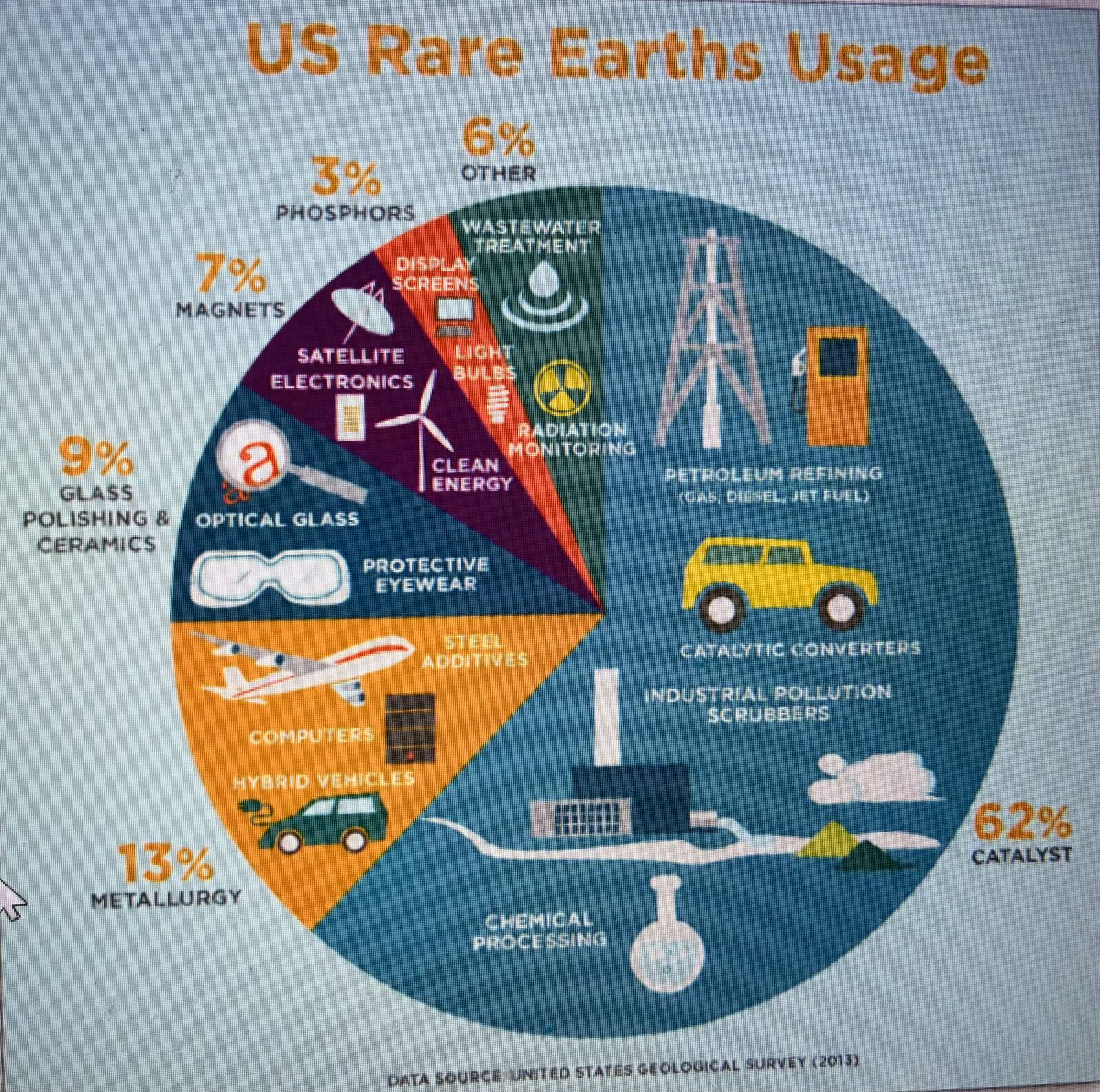
Rare Earth Elements are 17 elements that play a vital role in the development of technology in various applications These include devices such as “…smart phones, digital cameras, computer hard disks, fluorescent and light-emitting-diode (LED) lights, flat screen televisions, computer monitors, and electronic displays. Large quantities of some REEs are used in clean energy and defense technologies.”[7]
Their wide range of applications, combined with robust supply chains increased their importance in areas of energy and economic security.
Of the 17 metals, neodymium, praseodymium, terbium and dysprosium are used in the creation of permanent magnets. The magnets they produce are among the strongest in the industry as they are used in critical technologies such as “…electric vehicles (EVs), wind turbines, industrial motors and AI data centres, as well as medical, aerospace and defence applications.”[8] The demand for these materials to produce the magnets have doubled since 2015 and is expected to increase by another third by 2030.[9] This increase is also due to the growth in automation, robotics and digital technologies, where permanent magnets allow for precise motion control, miniaturization and improving energy efficiency.
Chinese Restrictions
The largest producer of rare metal minerals is China. The International Energy Agency (IEA) reported that in 2024, China accounted “…for 60% of global mined production of magnet rare earths. For refining, the level of concentration is more pronounced, as the country represented 91% of global refined output. Its share is even higher for permanent magnet production. In 2005, China accounted for around 50% of the production of sintered permanent magnets, but its share expanded significantly to reach 94% in 2024. China’s extensive magnet production activity generates substantial economies of scale and provides a strong and stable demand base for upstream raw materials.”[10]
In 2025, China placed export controls on seven heavy rare earth elements in retaliation for the Trump Administration placing tariffs on Chinese goods and semiconductor controls. When China announced its first round of export restrictions on April 4th, 2025, heavy rare earth elements and permanent magnets, global supply chains were sent into a tailspin. In the following weeks, “…the auto industry in the United States, Europe, and Japan reported supply disruptions that threatened to bring domestic manufacturing to a halt.”[11]
In October 2025, China announced additional rare earth export controls on five more rare earth elements. In addition to expanding controls on individual elements, processing equipment and technologies, these controls “…included a new licence requirement covering the trade of any internationally made ‘parts, components and assemblies’ containing Chinese-sourced rare earth materials or produced using Chinese technologies.”[12] These new restrictions “…marked a major escalation of scope, with significant potential implications across a wide range of strategic downstream sectors, including energy, transport, defence, aerospace, semiconductors and data centres.”[13]
Conclusion
If China was able to implement the export controls in full, the United States and Europe would face economic losses estimated at over $1.5 trillion dollars each. Based on downstream production total economic value for countries outside of China reaching potentially $6.5 trillion per year.[14]
The IEA report lists the following economic values of industries at risk from full export controls outside of China:
- Automotive: $3.30 trillion
- Defense: $0.59 trillion
- Portable Electronics: $1.01 trillion
- Aviation/trucks and trains: $1.07 trillion
- Data centre servers: $0.37 trillion
- Wind: $0.07 trillion
- Other: $0.10 trillion[15]
Footnotes
[1]https://www.reuters.com/legal/government/trump-may-need-allow-chinese-minerals-us-industry-struggles-meet-2027-deadline-2026-07-27/?utm_source=Sailthru&utm_medium=Newsletter&utm_campaign=Daily-Briefing&utm_term=072726&lctg=62fb99802babb15cdc0a4365&user_email=811ed8b292600ce981aafdcd541b60691ac1c024c7d281dc8621f11e98498b52
[2] Ibid.
[3] Ibid.
[4] Ibid.
[5] Ibid.
[6] Ibid.
[7]https://profession.americangeosciences.org/collections/geoscience-faq/how-do-we-use-rare-earth-elements/
[8] https://www.iea.org/reports/rare-earth-elements/executive-summary
[9] Ibid.
[10] https://www.iea.org/reports/rare-earth-elements/executive-summary
[11] https://www.csis.org/analysis/rare-earth-export-restrictions-one-year-later
[12] https://www.iea.org/reports/rare-earth-elements/executive-summary
[13] Ibid.
[14] Ibid.
[15] Ibid.