
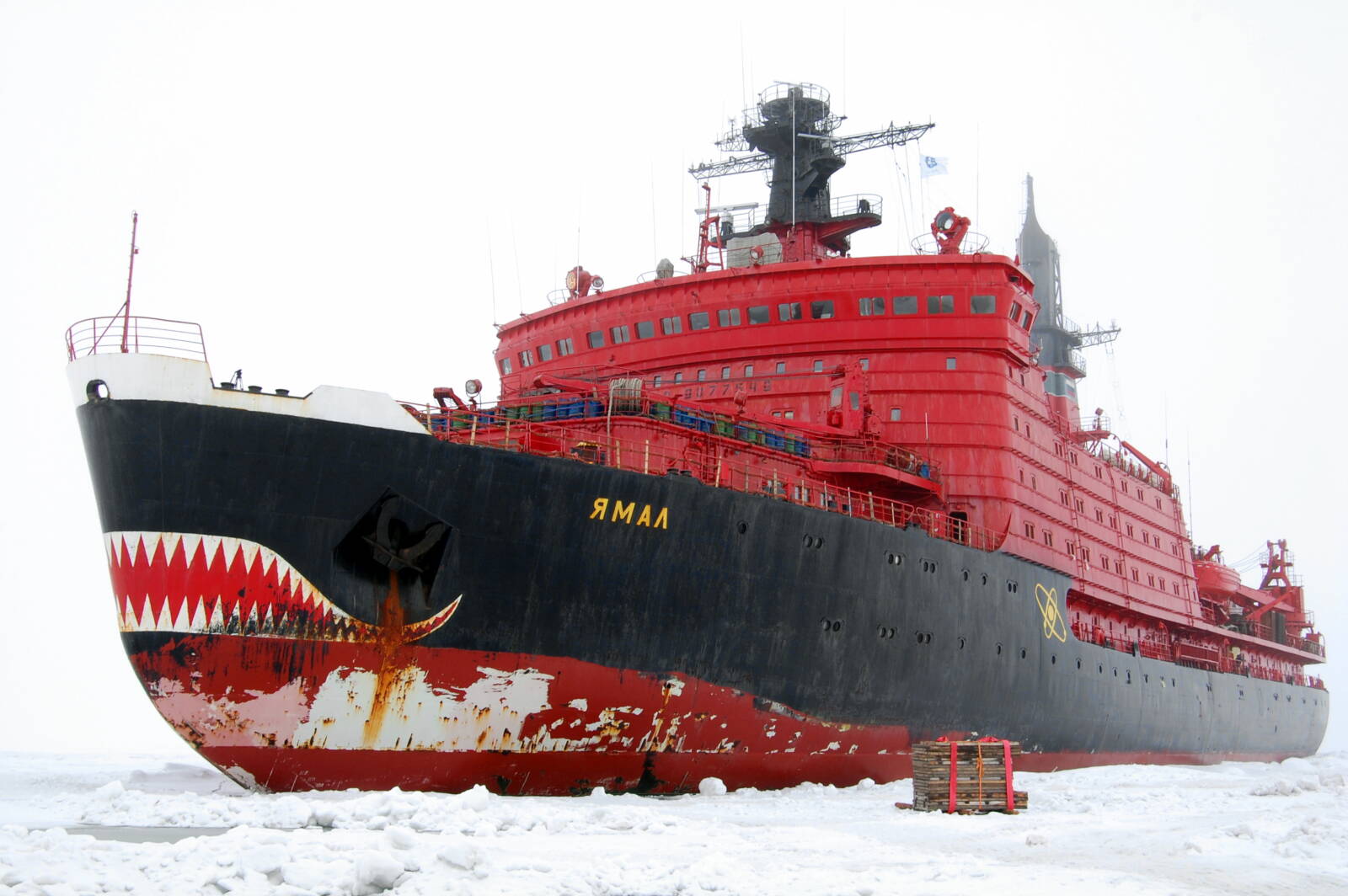
PHOTO: WIKIPEDIA
By Stas Margaronis
Two Chinese maritime professors have laid out a detailed risk analysis for supporting the construction of nuclear-powered commercial ships in which they conclude: “Vessels propelled by atomic reactors have low emissions but create other hazards that need clear regulations.”
This comes at the same time as the U.S. Maritime Administration has signed an agreement with nuclear technology developer CORE POWER to explore a pathway toward U.S.-flagged nuclear-powered commercial ships, expanding the Trump Administration’s push to bring small modular reactors into the maritime sector, according to GCaptain.[1]
The analysis, “Plans for nuclear-powered merchant ships must confront risks” appeared in the science magazine Nature on August 3rd. It was authored by Jihong Chen a professor at and director of the Shenzhen International Maritime Institute, Shenzhen University, Shenzhen, China and Zheng Wan, a professor at and director of the Department of International Shipping in the College of Transportation and Communications at Shanghai Maritime University, Shanghai, China.[2]
The authors argue that current low carbon fuels pose problems to ramp up for mass-commercial ship production: “The shipping industry needs low-carbon fuels if it is to reach net-zero greenhouse-gas emissions by 2050. But options are limited. Batteries can power ferries and vessels for use in harbours, but are impractical over long distances. Methanol is hard to produce sustainably. Ammonia is toxic and its supply chain is polluting. Hydrogen is too bulky and difficult to store safely at sea. Nuclear reactors are being eyed as a solution. Atomic energy produces no direct carbon dioxide emissions and avoids the need to store several thousand cubic metres of fuel on board, freeing up space for cargo. Using nuclear power could shorten voyage times by eliminating refueling stops and attaining higher speeds. It could save a ship owner tens of millions of dollars per ship per year in marine fuel costs and carbon taxes.”
While this appears to be a compelling argument to embrace nuclear-powered ships, the authors note some past history and present-day hazards. As a result, before nuclear-powered ships reach the seas, “a merchant ship fitted with a reactor is a mobile nuclear facility that needs to be treated with great care. It could be hijacked, run aground or even come under missile attack.” As a result, “the world needs to develop robust regulations around them. Engineers, regulators, ports and shipping companies must make these vessels safe and controllable. But current rules are outdated and fragmented.”
The authors note that two major efforts are under way: 1) In Washington, D.C., the International Atomic Energy Agency (IAEA) brings “nuclear and maritime regulators together at the launch of its Atomic Technologies Licensed for Applications at Sea (ATLAS) initiative. In June 2025, the International Maritime Organization (IMO) began revising its 1981 Code of Safety for Nuclear Merchant Ships, and expects to adopt a revised code in 2030.”
The authors lay out “what is at stake and call on the IAEA and IMO to link reactor licensing, ship certification, port entry and emergency response into one framework, lest companies, ports and countries implement incompatible systems and a nuclear accident at sea ensues.”
EARLY FAILURES
Early civil nuclear-powered merchant ships failed to achieve broad commercial success: “Just four have been built. Launched in 1959, the NS Savannah was part of US president Dwight Eisenhower’s Atoms for Peace programme. It was able to travel the world and dock in many ports. But the complicated procedure for obtaining permits for visits and berths made it unviable as a cargo ship.”
Military records show where stress and poor planning can lead: “Soviet nuclear-powered submarines have experienced loss-of-coolant accidents, unexpected power surges and damage to the reactor core. On the K-19 submarine in 1961, emergency repairs to restore cooling exposed sailors to lethal radiation. On K-27 in 1968, a liquid-metal-cooled reactor accident led again to fatal radiation exposures. On K-431 in 1985, a power surge during refueling at Chazhma Bay, near Vladivostok, caused a steam explosion, killing several workers and contaminating the surrounding area.”
NEW TECHNOLOGIES
Most early ships ran on low-enrichment uranium fuel, much as a civil nuclear power station does. But current propulsion options are more diverse7. They include: “technologies developed from long experience with icebreakers and small modular reactor programmes, such as light-water, high-temperature gas-cooled, lead-cooled fast, molten-salt and heat-pipe reactors. Other experimental designs are on the table. However, an expanded technology menu only poses more safety questions. Any reactor-powered ship requires licensing, insurance, crewing, upkeep, port acceptance, emergency preparedness and response and support for decommissioning.”
Newer reactor designs can reduce some of the hazards, especially when they operate at low pressure and have sealed cores, systems for removing excess heat and robust containment structures: “But advanced approaches mainly shift problems rather than eliminating them. A molten-salt reactor might avoid high-pressure coolant accidents, but regulators still need to know whether salt corrosion can be managed after prolonged exposure to vibration. They will also be concerned about management of tritium and volatile fission products, adequate shielding and reliable removal of heat from radioactive decay after shutdown. A port license is also a safety license. A nuclear-powered ship will require a reactor license, ship certificates and port authorizations. Each involves separate judgements and permissions.”
SAFETY
For the nuclear regulator, the core questions surround: “reactor safety, radiological protection and nuclear security. For the flag state, they include seaworthiness and crew safety. The port authority is concerned mainly with whether the vessel can enter the harbour, berth, discharge cargo, take refuge or be held in port without risk to the surrounding community.”
For a conventional ship, these decisions are standard: “For a nuclear-powered vessel, the relationships are more complex. If the harbour master, pilot, terminal operator, underwriter or emergency services are unable to understand the safety assurances provided by the reactor license, then the document has little practical meaning.”
A naval architect who reviewed the Chinese analysis said he agreed with most of the conclusions particularly as green ammonia, methanol, and hydrogen have not yet been found to have long-term viability as marine fuels: “The use of nuclear power in commercial shipping can only be done if the nuclear reactor technology has progressed … and regulations are further developed to support the use of nuclear energy … clearly the use of pressurised water reactors are not the right type of energy source. Then again this can also be said of other new emerging fuels like methanol and ammonia if even these fuels will be able to sustain the transport requirements of today … Certainly nuclear energy has still a long way to go and some issues may perhaps never be resolved (e.g. the war risk). But such risks would also pertain to the use of methanol, ammonia and even (bio or synthetic) LNG as well as even fuel oil…”
THE WAR-RISK GAP
Iranian-supported Houthi militias in Yemen have repeatedly used drones, missiles and unmanned boats against commercial shipping. If a nuclear-powered ship were to transit such waters, it could face the same missiles, drones, terrorist boarding attempts and electronic disruption as do conventional ships.
The authors note that while a marine reactor cannot explode like a nuclear weapon, other nuclear power aspects have much greater consequences:
- Damage to fuel, loss of shielding or coolant, hydrogen fires or steam explosions can release radioactive material and contaminated firefighting water, and create a shipwreck that no port is willing to receive.
- A missile attack could make a maritime reactor unsafe: “A strike that hits the bow or a container stack might not reach a reactor located near the middle of the ship. However, a strike that hits the engine room, switchboard, emergency generator, control cables or cooling-water intakes could disable the systems that support a safe shutdown.”
- A ship hit below the “waterline could compromise the vessel’s stability and flood compartments that are assumed to stay dry in the reactor design. “
- The reactor must be “designed to shut down automatically after severe impact, fire, flooding, a blackout, loss of propulsion or loss of communications.”
- There is an extra human-factor test: “What happens if the captain is dead, the engineering crew has been kidnapped, the security guards have left, or attackers take control of the ship? A design that is safe only when the full crew remains on board is unsuitable for dangerous waters.”
TOUGH REGULATION
The authors argue that a regulatory assessment should state: “what the on-board reactor is, what operational restrictions are in place, and what assumptions are made for the approved route. It must include plans for how shutdown and decay-heat removal are to be managed, which accident pathways have been evaluated, who has command of the emergency operations, and what information will be monitored and shared.”
The assessment should capture war risks as well: “Although sensitive design information that could reveal a ship’s vulnerabilities should remain confidential, the components of the threat envelope must still be defined: collision, fire, drone strike, direct missile hit, underwater explosion, cyber intrusion, hijacking, crew evacuation, sinking and denial of refuge.”
Regulatory authority should remain with public institutions: “The IMO and IAEA need a joint framework, not two separate systems that cause confusion.”
The authors conclude by warning: “Nuclear power is not simply a cleaner propulsion option. In a world in which commercial shipping is already being attacked, the risks and burdens must be taken seriously.”
FOOTNOTES
[1] https://gcaptain.com/u-s-takes-next-step-toward-nuclear-powered-commercial-ships/
[2] https://www.nature.com/articles/d41586-026-02388-6