

Source: AI Futures Project.
“We think the world is asleep at the wheel. People say the words ‘AI will be transformative’ without thinking concretely and seriously about the implications of broadly superhuman AI. AI companies, lobbyists, and think tankers often offer incremental proposals to decrease risk around the edges, but only rarely offer ambitious plans aimed at actually solving the big problems… “ – from AI 2040
By Kevin Policarpo
Humanity has a limited time to choose from several scenarios that may or may not create sufficient regulation and human control over AI development so as to avoid a catastrophic outcome, according to a research group AI Futures Project.
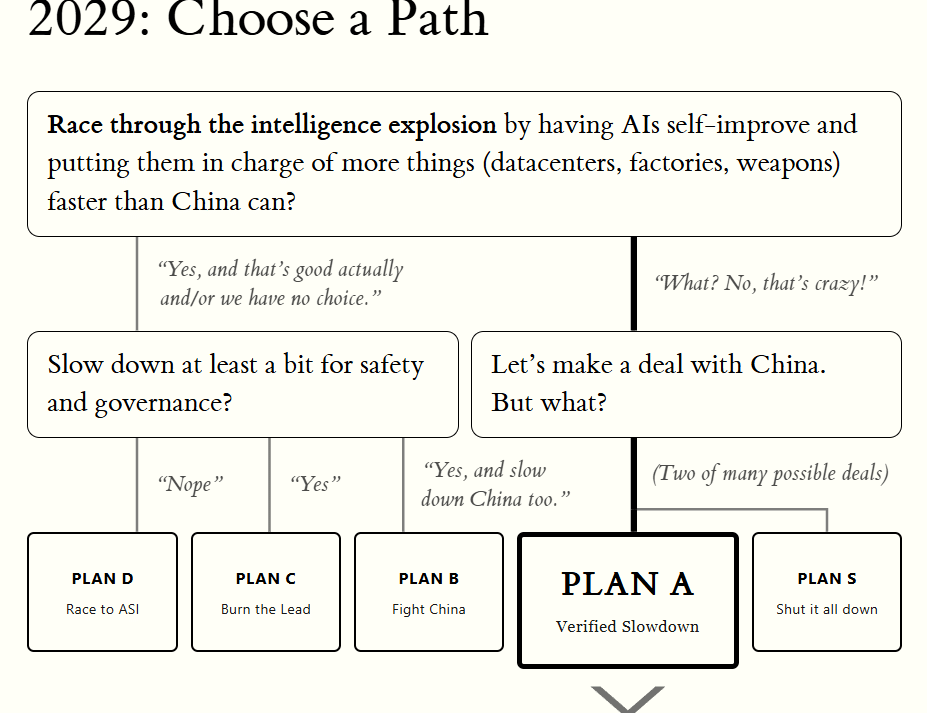
The group issued a report entitled AI 2040 proposing scenarios that could mitigate the threat that AI poses. The AI Futures team lays out five possible plans that are summarized by the illustration below but prefers what it calls Plan A.
The AI 2040: Plan A scenario is the third major release from the AI Futures Project, alongside AI 2027 and the AI Futures Model. The AI Futures project is “a research nonprofit working to forecast the future of advanced AI and (now) offer recommendations for navigating it. We created this website in collaboration with Lightcone Infrastructure.”
The AI Futures team says: “Plan A is our positive vision for how humanity can avoid AI-driven existential catastrophe and reach a flourishing future. It’s informed by conversations with experts at major U.S. frontier AI companies, direct experience at OpenAI, tabletop exercises, and discussions with policymakers, national security experts, and AI policy leaders. We recommend an international deal to avoid a dangerous race to superintelligence. The deal involves total research transparency for AI R&D, which allows the nations of the world to understand what’s happening and enforce guardrails. The result is multiple companies across multiple countries scaling slowly and safely together towards superintelligence, instead of racing each other in secrecy.
Source: AI 2040
Plan A is primarily a recommendation, not a prediction. This scenario is not our best guess as to what the future will actually look like. Instead, it’s a vehicle for communicating and stress-testing our policy recommendations. While the implementation of Plan A is a recommendation and not what we actually expect to happen, the subsequent effects depicted are predictions. In this AI 2040 scenario, Plan A is implemented successfully, albeit imperfectly and only in the nick of time.”[1]
POSTSCRIPT
In a Postscript, the team warns:
“We think the world is asleep at the wheel. People say the words ‘AI will be transformative’ without thinking concretely and seriously about the implications of broadly superhuman AI.
AI companies, lobbyists, and think tankers often offer incremental proposals to decrease risk around the edges, but only rarely offer ambitious plans aimed at actually solving the big problems.
We think that following only incremental proposals will lead to a scenario like the race ending of AI 2027, in which misaligned AIs take over. If we get lucky and alignment is easier than expected, then they’ll lead to a scenario like the slowdown ending of AI 2027, in which a tiny group of individuals get to decide the shape of the future and could easily become permanent oligarchs if they so choose. Something more ambitious must be done. But what?
Politicians should be banging at the door of the AI companies, asking them for a comprehensive overall plan for how companies and governments should act from now until superintelligence, which should be similarly detailed to Plan A. Then, people should apply scenario scrutiny to these plans, asking questions like ‘what would it look like to implement them? How long would it take? What would happen next? Who would build superintelligence, and when, and how? What assumptions does success depend on?’
We at the AI Futures Project are attempting to be the change we wish to see in the world. We do so with some trepidation, knowing that a detailed plan has a wider attack surface than one that keeps things conveniently vague. We hope critics will judge us against the existing state-of-the-art for plans to navigate the AI transition (if they can find any) and not against some hazy but pleasant fantasy where no one has to make any hard choices yet everything will probably be fine.
Sometime in the next few years the US government will be in crisis mode, pondering what to do about scarily powerful AIs and blisteringly fast AI progress. We think the choice is not an easy or a simple one. Plan A is our current best guess, but hopefully a better plan will exist before it’s too late. We hope that the best ideas from Plan A will be adopted and the worst ideas discarded.”[2]
FOOTNOTES
[2] Ibid.